
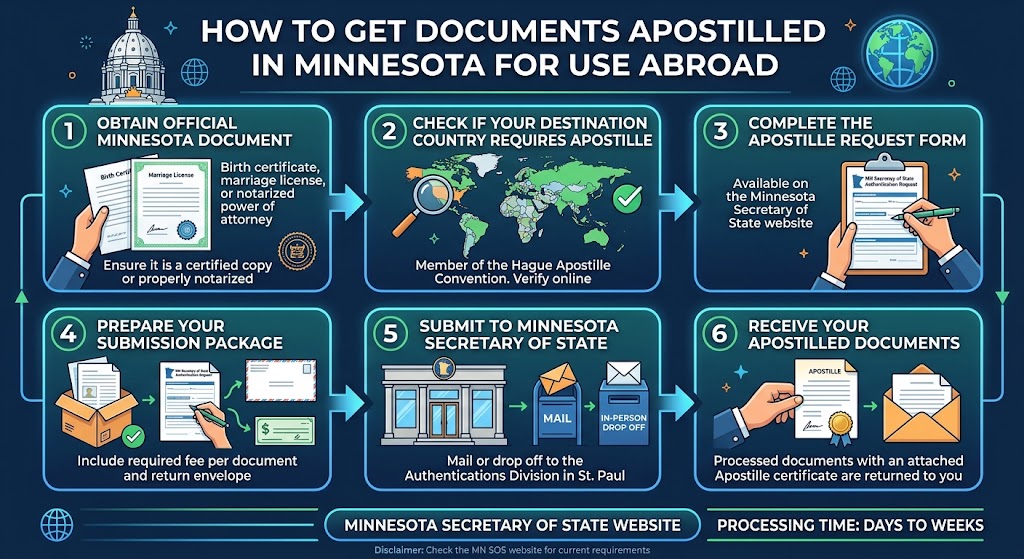


A record that passes without question inside Minnesota can stop at a foreign counter, where the seal on it means little to the person holding it. The certificate that closes that gap is an apostille. This article covers what the certificate does, how the destination shapes the route, which Minnesota records are usually sent, and what the office asks for before it issues one.
What an Apostille Does
An apostille certifies the origin of a public document — the signature on it, the capacity in which that person signed, and the seal or stamp the paper carries. That is what Minnesota document authentication through the Secretary of State covers, and it lets an official abroad rely on the paper without tracing it back through a chain of offices.
The certificate concerns the document’s origin rather than its content. An affidavit with a Minnesota apostille issued remains the sworn statement of whoever signed it. An apostille does not establish that the underlying facts are correct.
Check the Destination Country First
The Apostille Convention of 1961 counts 130 Contracting Parties. Among those states, one certificate, attached where the document was issued, takes the place of the consular stamps that once had to be collected one office at a time. Hague Convention documents can therefore travel with a single apostille attached to the original.
Minnesota has simplified half of this. Since 15 May 2018, the Minnesota Secretary of State’s office has issued a single Apostille for documents intended for use outside the United States, regardless of the country of destination. The certificate therefore does not change based on whether the destination country is a party to the Hague Convention.
The Apostille does not determine whether additional authentication is required in the destination country. For countries outside the Hague Convention, the document may need embassy legalization for Minnesota papers after the state-level certificate. Check with the destination country’s embassy or consulate to confirm whether any further authentication is required.
Minnesota Documents Commonly Submitted
The Secretary of State accepts certified Minnesota public records and documents notarized by a Minnesota notary. What each type needs before submission differs:
- Vital records — certified birth and death certificates from the Minnesota Department of Health, and certified marriage records from the county where the marriage was filed.
- Court documents — certified copies of divorce decrees and judgments obtained from the county where the proceedings took place.
- Notarized papers — powers of attorney, affidavits, consents, and similar documents signed before a Minnesota notary with a valid commission.
- Education records — diplomas and transcripts from Minnesota schools, colleges, and universities, which must be properly notarized.
- Business papers — certified copies of business organization documents on file with the Minnesota Secretary of State.
When a state or county office holds the underlying record, obtain a certified copy before submitting it for apostille. That is the route for a birth certificate apostille in Minnesota. A power of attorney follows a different route: it must first be properly notarized before it can receive a notarized document apostille.
Step-by-Step Minnesota Apostille Process
Most requests come down to three steps, each one finished before the next begins:
- Obtain the right version. Get a certified copy of a public record from the authority that holds it, or prepare the original document for notarization if it is a document such as a power of attorney or affidavit.
- Add the notarization or certification the type calls for. A document signed before a Minnesota notary must be properly notarized, while a court record must be submitted as a certified copy issued by the court or county office that holds the record.
- Submit it with the form and the fee. A Minnesota Secretary of State apostille costs $5 per certificate. Requests can be mailed with the completed Authentication Request Form, the document, and payment, or submitted by appointment at 332 Minnesota Street, Suite N201, in Saint Paul. Mail requests are processed in the order they are received; a prepaid return label can provide tracking for the documents coming back.
A missing certification adds a round trip to the post, which is what a Minnesota apostille service is usually hired to prevent. Where the calendar is tight, the sequence can be handed over whole — Minnesota apostille providers order the certified copy, arrange the notarization, and file the request in one pass.
Common Reasons for Rejection or Delay
A request can be delayed when the document does not meet the requirements for its type or when the submission is incomplete. Common problems include:
- A notarized document with a missing or incomplete required element.
- A document notarized after the Minnesota notary’s commission had expired.
- A photocopy or uncertified copy submitted where a certified copy is required, including for eligible vital records.
- A missing Authentication Request Form or required payment.
Before You Send the Document
One review before posting removes most of the faults listed above. Confirming the destination’s own requirements with its consulate belongs in that review, translation included, because the certificate speaks to origin and leaves the language question to whoever reads the file.
Anyone who has to apostille documents in Minnesota on a deadline should allow for the possibility of a rejection. A package that goes out in order usually makes the trip once, and that margin is what keeps a consulate appointment in place.