
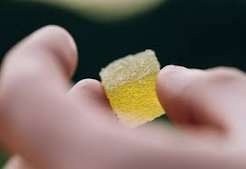


CBD gummies are easy to recognise, but their labels are not always easy to interpret. One bag may advertise 500 mg of CBD, another 1,000 mg, and a third may emphasise the amount in each individual sweet. None of those numbers tells you how many gummies are appropriate to eat. The most useful starting point is the current UK food-safety guidance, followed by a careful look at what is actually in the product.
This guide explains how to read CBD gummy strengths, what the Food Standards Agency (FSA) advises, why one gummy may already be more than the recommended daily amount, and which people should avoid CBD food products. It is consumer information, not an individual dosing instruction or a recommendation to use CBD for a medical condition.
The Short Answer: There Is No Universal Number of CBD Gummies
There is no standard answer such as “take one or two gummies” that applies across all brands. Gummies differ enormously in CBD content, and personal circumstances matter too. The FSA currently advises healthy adults to limit CBD from food to 10 mg per day. This is precautionary consumer safety advice, not a dose shown to produce a particular benefit and not an assurance that CBD is risk-free.
A gummy containing 5 mg is therefore a very different proposition from one containing 25 mg or 50 mg. Even one of the stronger gummies is above the FSA’s current daily guidance. People taking medication, those who are pregnant or breastfeeding, children and people trying to conceive are among the groups advised not to consume CBD. Anyone with a health concern should seek professional advice rather than selecting a quantity based on a general blog post.
What Does the FSA Say About CBD Amounts?
Why the Figure Is 10 mg, Not 70 mg
You may still see UK product pages recommending up to 70 mg of CBD a day. That figure comes from older FSA advice. In October 2023, the agency revised its precautionary guidance following new evidence and scientific review, advising healthy adults to limit CBD from food to 10 mg daily. The advice remained reflected in FSA publications during 2026.
The guidance covers CBD taken in food products, including gummies, drinks, drops and edible oils. It is concerned particularly with possible risks associated with repeated, long-term exposure. The 10 mg figure is not a legal sales limit, a prescription or a promise of safety for every individual.
Count CBD Across All Food Products
The FSA guidance concerns overall daily CBD consumption from food, not an allowance for each separate product. Someone who uses a CBD gummy and also takes CBD oil or drinks a CBD beverage could consume more than they realise. Checking every relevant label is more useful than focusing only on the quantity suggested by a single manufacturer.
Understanding CBD Strength Per Gummy
Packaging often gives the total CBD content of the bag in much larger print than the amount per sweet. To calculate the per-gummy amount, divide the stated total CBD by the number of gummies, provided the product is formulated and labelled consistently.
For instance, a pack containing 20 gummies and 200 mg CBD in total would contain an advertised average of 10 mg per gummy. A 500 mg pack of 20 gummies works out at 25 mg each. A 1,000 mg pack of 20 gummies works out at 50 mg each. These are examples of label arithmetic, not suggested serving sizes.
When comparing vegan CBD gummy bears, look beyond the total pack strength and identify the milligrams in each individual gummy. Haze’s current range, for example, lists 25 mg and 50 mg options. Both amounts exceed the FSA’s precautionary 10 mg daily guidance for healthy adults, even when only one whole gummy is consumed.
Why Half a Gummy Is Not Automatically the Answer
Cutting a 25 mg gummy in half gives a theoretical average of 12.5 mg, which is still above 10 mg. Cutting it into smaller pieces creates an even less dependable measurement. The CBD may not be distributed perfectly evenly, and cutting sweets by eye is not a validated dosing method. Choose based on verifiable labelling rather than assuming that a fraction of a high-strength gummy delivers an exact amount.
Seven Checks Before Considering a CBD Gummy
1. Read the Amount Per Individual Piece
The first number to find is mg CBD per gummy. “1,000 mg” on the front of a bag may refer to the entire pack, not one serving. If the amount per piece is unclear, the label does not provide enough information for an informed comparison.
2. Compare It With Current UK Guidance
Compare the per-piece figure with the FSA’s 10 mg daily advice for healthy adults. If one whole gummy exceeds that figure, do not assume the manufacturer’s serving suggestion overrides official safety guidance. Higher CBD concentration does not automatically make a product better.
3. Check Other CBD Sources
CBD can be present in oil drops, capsules, drinks and other foods. A daily total should consider all edible CBD products, including items that are easy to overlook because they are described as wellness snacks or flavoured sweets.
4. Read the Full Ingredients List
Check sweeteners, allergens, flavourings and the ingredients used to set the gummy. Products advertised as vegan should use an appropriate alternative to animal-derived gelatine. Dietary suitability and cannabinoid concentration are separate quality questions; neither proves a product is safe.
5. Ask for a Batch-Specific Lab Report
A certificate of analysis can help verify the stated CBD content and reported cannabinoid levels. Match the batch number and product name, look at the date, and check which tests were performed. A vague “lab tested” badge is less informative than a relevant report from an independent laboratory.
6. Check the Product’s Regulatory Position
CBD is treated as a novel food ingredient in the UK. The FSA maintains a public list of products linked to applications, but inclusion on that list is not itself an authorisation or an endorsement of safety. Rules and enforcement arrangements can vary among the UK nations, so consumers should not treat a retailer’s broad “FSA approved” claim as sufficient evidence.
7. Consider Whether CBD Is Appropriate at All
If you take prescribed medication, are pregnant or breastfeeding, are trying to conceive, are under 18 or have other relevant health concerns, do not use a general online dosing chart to make the decision. The FSA advises several of these groups to avoid CBD, and medicines can interact with it. Speak with a clinician or pharmacist where appropriate.
How Long Do CBD Gummies Take to Be Processed?
Gummies must pass through the digestive system, so absorption is different from swallowing a liquid preparation or inhaling an aerosol. The timing can vary with the product, food intake and individual physiology. Online descriptions that promise a precise onset or duration should be treated cautiously.
A delayed or subtle experience is not a reason to consume extra gummies in quick succession. Doing so can increase total intake without providing a reliable way to predict the result. Gummies should also never be presented as a substitute for prescribed treatment or professional guidance.
Potential Side Effects and Why Labels Matter
CBD is not risk-free merely because it appears in a confectionery format. The FSA has highlighted concerns about possible long-term effects, including effects on the liver and thyroid, as part of its precautionary advice. Individual products may also contain ingredients that cause unwanted reactions or may be unsuitable for particular diets.
Possible unwanted effects reported with CBD include digestive upset, appetite changes and drowsiness. CBD can also interact with medicines. Do not assume that a high street product is clinically tested in the same way as a licensed medicine, or that an attractive flavour makes its ingredients harmless.
Store gummies in their original packaging, away from children and pets. Their resemblance to ordinary sweets can make accidental consumption more likely, especially when a pack has bright colours or fruit flavours.
Frequently Asked Questions
Is One CBD Gummy a Day Too Much?
That depends on the amount in the gummy. One 5 mg or 10 mg product is not equivalent to one 25 mg or 50 mg product. A single gummy containing 25 mg or 50 mg already exceeds the FSA’s current 10 mg daily guidance for healthy adults. The guidance is precautionary, not proof that a lower amount is suitable for everyone.
Can I Take Two Gummies If the Label Says One Is a Serving?
The serving size printed by the seller does not replace official consumer safety advice. Two gummies could mean very different CBD totals depending on the product. Check the amount per piece, count all other CBD food sources and avoid treating manufacturer serving suggestions as a personalised recommendation.
Are 25 mg CBD Gummies Suitable for Beginners?
A 25 mg gummy contains more than twice the FSA’s 10 mg precautionary daily guidance. It should not be recommended as a routine beginner serving simply because it is the lower-strength option in a particular range.
Can CBD Gummies Be Used With Prescription Medicines?
CBD may interact with medication. The FSA advises people taking medication not to consume CBD without appropriate medical advice. Ask a doctor or pharmacist rather than trying to solve the question by taking a smaller gummy or spacing the timing apart.
Final Thoughts
The most responsible answer to “how many CBD gummies should you take?” is not a fixed number of sweets. It starts with the amount of CBD in each gummy, the total from all food sources and the FSA’s present precautionary guidance of 10 mg per day for healthy adults.