
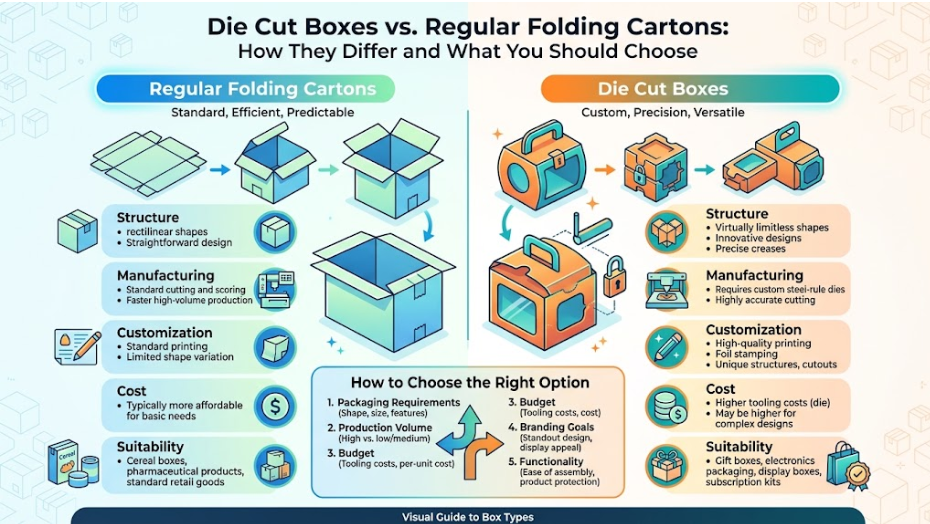


Each box supplier will have their own opinion on what’s best for your product since it’s in their best interest. However, die cut boxes and regular folding cartons are not interchangeable, so choosing the wrong option can cost you dearly in returns, which may not be immediately apparent
Here’s the honest breakdown.
What Makes Die Cut Boxes Different
A steel blade, shaped like the exact box you want, presses into cardboard sheets and cuts the whole outline in one go. That’s die cutting cardboard. It’s why these boxes have sharp edges, tight folds, and shapes you won’t find on a shelf of standard cartons.
Folding cartons work off pre-existing templates. Fold flat, pop into shape, done. No surprises, which is exactly the point.
Cost
Folding cartons cost less upfront. The tooling already exists, so you’re not paying a setup fee just to get started.
Die cut packaging boxes need a custom die first, and yes, that adds cost at the front end. What most people don’t factor in: that die gets reused. Order die cut boxes at volume and the per-unit price drops fast — sometimes faster than people expect. If you’re testing a product with a small budget, go folding carton. If you’re scaling, the math flips in favor of die cut pretty quickly.
Durability
Die-cut boxes hold up better under weight and pressure, mostly because the process allows for double-wall or triple-wall board. Heavy products, fragile items, anything traveling a long distance — die cut structure handles it better.
Folding cartons aren’t flimsy. They’re just built for lighter loads. Cosmetics, small retail goods, food that isn’t shipping across the country. Different job, not a worse one.
Customization
Window cutout? Hexagon shape? A sleeve that slides open sideways instead of lifting off the top? Custom die cut boxes can do this. The blade shapes to whatever the product needs.
Folding cartons can’t really compete here. You can print any design on the surface, but the shape stays inside a narrow set of templates. Got a product with an odd form factor? A stock carton won’t fit it the way custom boxes cut with a die will.
Shipping
Die cut cardboard packaging can include reinforced corners, snug internal fits, structural creases that absorb impact. This is why e-commerce brands’ shipping breakables lean toward die cut almost by default.
Folding cartons are lighter, which helps on shipping costs when you’re moving high volume. But lighter usually means less padding as well. You have to consider how many times the package will change hands before it reaches the consumer. Think about it, there can be up to 12 hands involved between the warehouse and the front door
Branding
A printed folding carton is still an attractive display. Nobody is disputing that.
But shape is branding too, and that’s where die cut boxes pull ahead. An unusual silhouette gets noticed before anyone reads the label — on a shelf, in an unboxing video, wherever. Flat printing alone doesn’t do that.
If shelf presence or the unboxing moment matters to your brand, die cut packaging boxes are worth the extra thought.
Product Protection
Glass, electronics, anything with sharp corners or weight that shifts around — these need the structural backbone that comes from die cutting cardboard. A tighter custom fit means less movement inside the box, and less movement means less damage.
Softer goods, apparel, anything that doesn’t really shift in transit, can get by fine with a folding carton. Less material, lower cost, still does the job.
Lead Time
People forget to ask about this until it’s too late. Folding cartons ship fast — templates already exist, so an order can go from days to your dock, not weeks.
Die cut boxes take longer the first time. Cutting a new die isn’t instant. Expect extra lead time, sometimes close to two weeks depending on the supplier and how complicated the shape is. Once the die’s made, though, reorders move at the same speed as folding cartons. It’s a one-time wait, not something that will happen every time.
If you are planning a launch in the next week build this into your timeline early. A great product sitting in a warehouse because the boxes aren’t ready is a bad way to start.
So What Is the Right Choice?
The choice highly and at times solely depends on the product that you are shipping, and also the unboxing experience that you would like your customers to have.
If you want to try something new and that too on a small budget. Go with a folding carton.
Scaling up, shipping something fragile, or trying to build a brand people remember after one order? Custom boxes are worth paying for.
Either way — ask about wholesale die cut boxes pricing before you commit to a run. Bulk is far more impactful than you think. Things that seem cost prohibitive at first, turn out cheaper when in bulk. Make sure the box matches the product and not the other way around.