
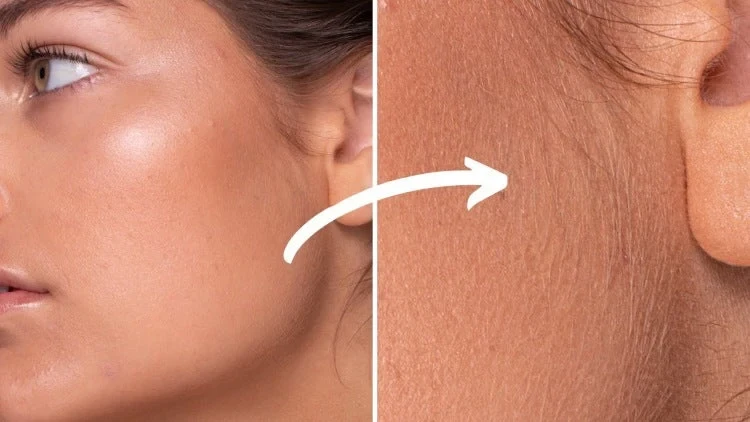


Facial hair has absolutely no interest in consistency. The soft fuzz on your cheeks behaves nothing like that one determined chin hair that somehow returns overnight. Your lip fuzz can be more visible, sideburns may grow longer, and eyebrow strays seem to appear precisely when you are already late.
Yet facial hair grooming advice often treats all of it as one problem: remove hair, achieve smooth skin, done.
Not quite.
Different areas of the face have different hair textures, growth patterns and levels of sensitivity. That means using a Women’s Facial Hair Trimmer effectively is less about running it everywhere and more about knowing what each zone actually needs.
And if you are trying to identify a good trimmer for women, the smartest place to start is not the product specification sheet. Start with your own face.
Zone 1: Peach Fuzz is Fine Hair, Not a Grooming Emergency
The cheeks and sides of the face commonly have soft, fine facial hair. It may become more noticeable in sunlight, under makeup or during one of those dangerously close encounters with a magnifying mirror.
But visible does not automatically mean it needs removing.
Some women prefer taking peach fuzz off because they like how skincare or makeup feels afterwards. Others genuinely cannot be bothered. Both choices are completely normal.
If you do groom this area with a women’s facial hair trimmer, work systematically rather than repeatedly passing over the same patch because you can still see microscopic hair under bathroom lighting.
A useful reality check? Step away from the mirror after grooming and look at your face from a normal distance. Nobody at brunch is studying your cheek from four centimetres away.
Zone 2: Upper Lip Hair Needs Precision, Not Panic
Upper lip hair can feel much more noticeable because it sits in the centre of the face and may appear darker than surrounding peach fuzz.
This is where control becomes important.
A good trimmer for women should allow you to work around smaller areas without requiring aggressive pressure. Keep the skin comfortably taut and move carefully around the corners of the mouth rather than rushing from one side to the other.
Also consider timing.
If removing upper lip hair sometimes leaves temporary redness, doing it exactly 90 seconds before applying foundation for a wedding may not be your finest planning moment. Groom earlier when possible and give the area a little time before layering multiple beauty products over it.
Your makeup bag does not need that plot twist.
Zone 3: Chin Hair Plays by Completely Different Rules
Here is where facial grooming gets interesting.
Chin hair can sometimes be noticeably coarser than cheek fuzz. You may have only one or two strands, or a larger area you prefer to groom regularly.
That does not mean you should attack your entire chin every time one hair appears.
When using a women’s facial hair trimmer, first identify whether you are dealing with scattered coarse hairs or a broader patch of finer growth. For a couple of obvious strands, a precision approach makes far more sense than repeatedly trimming surrounding skin.
There is also no universal schedule. Some people groom weekly, others occasionally, and some simply deal with individual hairs when they notice them.
Your facial hair does not need a content calendar.
Zone 4: Sideburns Are About Shape as Much as Hair Removal
Sideburn grooming is one of those things that can escalate extremely quickly.
You start shortening a little hair near the ear. Then one side looks different from the other. So you “even it out”. Five minutes later, you are negotiating with yourself about where your hairline technically begins.
This is why a Good Trimmer for Women should offer control, but your technique matters equally.
Before touching the area, decide where you actually want the sideburn to end. Follow your natural hairline instead of continuously trimming upwards in pursuit of perfect symmetry.
Remember that sideburn hair also connects visually to the hair around your temples. Removing too much can create a sharper transition than you intended.
When in doubt, under-trim first. You can always remove more. Hair removal does not come with Ctrl+Z.
Zone 5: Brows Need Their Own Definition of “Neat”
Your eyebrows deserve special mention because they are facial hair, but treating them exactly like cheek or upper-lip hair is asking for chaos.
A women’s facial hair trimmer with a precision attachment may help tidy obvious stray hairs, but brow grooming is primarily about maintaining shape rather than simply removing everything outside a vague boundary.
Try the brush-first rule:
- Brush brow hair upwards and outwards.
- Look at the natural shape before removing anything.
- Deal only with hairs that genuinely sit outside that shape.
- Check both brows frequently instead of finishing one completely before starting the other.
The goal is sisters, not photocopies.
One eyebrow will probably always have slightly more main-character energy. Let her.
Here’s the Part Most Grooming Guides Miss: Hair Direction Changes Across Your Face
This is one of the most useful things to notice before deciding whether you have found a good trimmer for women. Facial hair does not necessarily grow straight down everywhere.
Hair around the sideburns may follow one direction, jaw hair another and upper lip hair another again. Even within the same zone, growth patterns can vary.
Before grooming, spend ten seconds observing the direction in which your hair naturally lies. It sounds ridiculously basic, but it can reduce the urge to move a tool randomly backwards, forwards and sideways trying to catch one stubborn strand.
Good grooming is often more observation than effort.
Your Skin Condition Matters More Than Your Grooming Schedule
You may normally remove facial hair every Sunday. That does not mean this Sunday is automatically a good idea. If your skin feels irritated, sunburnt, unusually dry or has recently been through an aggressive exfoliation session, consider whether grooming can wait.
Using a women’s facial hair trimmer does not need to be another compulsory step in an already packed skincare routine. Your skin gets a vote. Similarly, immediately surrounding facial grooming with scrubs, strong exfoliating products and every active ingredient on your shelf can turn a simple routine into unnecessary irritation.
Sometimes the smartest skincare move is doing less.
What Actually Makes a Good Facial Trimmer?
Instead of searching for one universally perfect device, think about your personal grooming zones.
A good trimmer for women should ideally make the areas you regularly groom easier to manage. Depending on your routine, useful considerations can include:
- Precision around smaller facial areas
- Comfortable handling and grip
- Easy cleaning
- Suitable attachments for the areas you groom
- Convenient charging or battery life
- Compact storage if you travel frequently
Someone who only tidies her upper lip has very different needs from someone who regularly grooms brows, chin, peach fuzz and sideburns.
That is why “best” without context is basically meaningless.
Build Your Grooming Routine Around Your Face, Not Someone Else’s
The biggest facial grooming upgrade may not be a new technique at all. It may simply be recognising that every patch of hair does not need identical treatment.
Your cheeks may need nothing. Your upper lip may need occasional maintenance. Your brows may need precision. Your chin may contain one rogue hair with the confidence of a CEO.
A women’s facial hair trimmer is simply a tool that lets you decide what stays and what goes. Finding a good trimmer for women can make that process easier, but the real skill is knowing when, where and how much you actually want to groom.
Your face has different zones, different hair and different priorities. Your body hair grooming routine is allowed to have different rules too.