
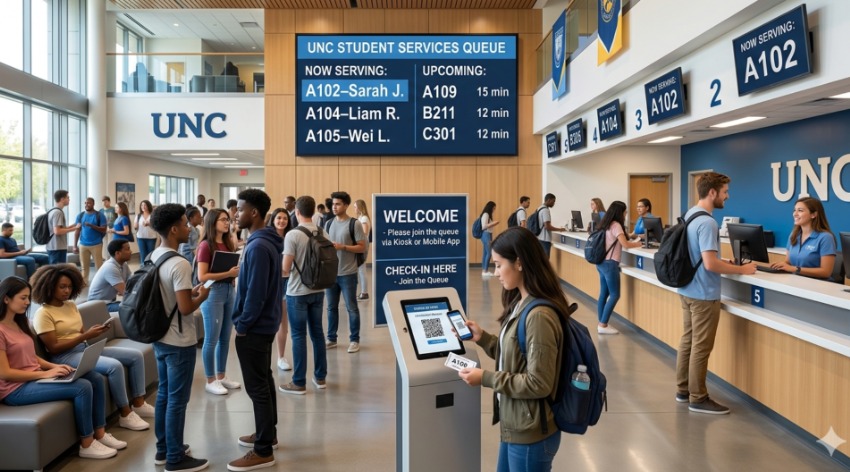


The first week of the Fall Semester should be charged with electricity. Freshmen are settling into their dorms, the quad is alive, and there’s actually a sense of a new beginning.
But step inside the student services building, and that great energy completely dies.
Instead, you find the “August Rush.” It’s a suffocating, slow-moving line of a hundred and fifty students spilling out of the financial aid office, wrapping around the hallway, and backing up past the registrar’s desk. Everyone in that corridor is stressed. Students are anxious about losing their classes, parents are tapping their feet, and the frontline staff looks like they are bracing for impact.
For decades, colleges treated these massive lines as an unavoidable rite of passage—a frustrating but normal part of the university experience. But it doesn’t have to be that way.
When institutions replace the physical line with education queue management software, something incredible happens to the data. Average student wait times drop by up to 60%.
More importantly, the entire climate of the campus changes. Let’s discover in the following blog how an education queue management system transforms university operations from the ground up.
The Invisible Costs of a Long Line
When a student stands in a physical hallway for two hours just to fix a minor scheduling error or turn in a single form, they aren’t just losing time. They are losing faith in the school.
For higher education leadership, legacy waiting models create three major friction points:
- Early-Semester Melt: When in the early days of college life, if the student finds admin questions confusing or has to deal with massive paperwork, they might freak out. Students may develop a feeling of being left out, ultimately giving up on their admissions even before it starts.
- Frontline Burnout: Your student services staff bear the brunt of everyone’s pent-up frustration. Standing at a window absorbing complaints for eight hours straight is exhausting, which is why turnover in these critical administrative roles is notoriously high.
- Total Data Blindness: If you rely on physical lines or paper tickets, you are flying blind. Registrars and VPs have no real-time data on average handle times, peak hours, or true bottleneck causes. You cannot fix what you cannot measure.
How the Software Slashes Wait Times
The education queue system doesn’t just digitize the old “take a number” ticket machine. It completely re-engineers how students interact with campus offices.
By restructuring the flow of people, schools consistently hit that 60% reduction mark through three practical mechanisms:
1. Virtual Queuing (Giving Time Back)
Students line up “virtually” using their cell phones, campus application, or a basic QR code at the building entrance, rather than waiting in a physical line. The system informs them of their position in the line and how long they are likely to wait, by text: “You are 4th in line. The estimated wait time is 14 minutes.
Then students can sit in the school cafeteria, have a cup of coffee, or study in the school library anytime they want, until it’s their turn. The psychological stress from waiting vanishes with the elimination of the physical crowd.
2. Intelligent Triage
Not all student issues take the same amount of time. A student who just needs to hand over a signed residency document shouldn’t be stuck behind someone walking through a complex, thirty-minute financial aid appeal.
When signing into the virtual queue, students select what they need. The software automatically routes them to the right staff member. Quick tasks are cleared out in seconds, preventing the entire system from backing up.
3. Staff-Side Preparation
When a student is called, the staff member’s computer screen automatically displays the student’s name, ID, and reason for their visit before they arrive at the desk. The transaction time is greatly reduced as the employee does not need to ask “how many” and “where can I find” simple questions, and then search for files for the first three minutes.
The Business Case: Staffing and ROI
University budgets are tighter than they have ever been, and every line item has to justify itself to the CFO. University and school queue management system isn’t just an “experience upgrade”—it is a direct operational cost-saver.
Without data, managers usually handle peak times by over-staffing “just in case,” which wastes valuable resources during slower hours. The software provides an analytics dashboard that maps out exact traffic patterns. You will see precisely which hours of the week are busiest and which departments are bottlenecked. This allows leadership to deploy staff dynamically, putting people exactly where they are needed, when they are needed.
Moreover, a calm environment significantly decreases employee turnover. It is much less expensive to keep experienced staff who are feeling supported by good systems than to continually hire and train new administrative employees.
Addressing the Common Hesitations
Whenever a university discusses moving to a virtual queue, leadership usually brings up two core concerns:
- “Will we lose the personal touch?” It actually does the opposite. Virtual queuing protects face-to-face interaction. When a student finally sits down with an advisor, both parties are calm. The conversation is focused and helpful, rather than rushed because fifty impatient people are staring through the glass window behind them.
- “Will our staff resist a new system?” Change can be hard, but frontline staff are almost always the biggest champions of this software once it goes live. It transforms their daily working environment from a noisy, high-pressure waiting room into a quiet, organized, and manageable workflow.
A Modern Campus Standard
Today’s students expect the organizations they deal with to respect their time. They order food on apps, track deliveries in real time, and manage their lives from their phones. When they arrive on a college campus and encounter a 1995-style physical waiting line, it creates a massive disconnect.
Reducing student wait times by 60% is a great metric for a brochure. But on campus, it means something much deeper. It signals to your students and their families that your institution is organized, modern, and genuinely cares about their well-being. When you remove the friction from the administrative process, you clear the path for what really matters: keeping students enrolled, focused, and moving toward graduation.