
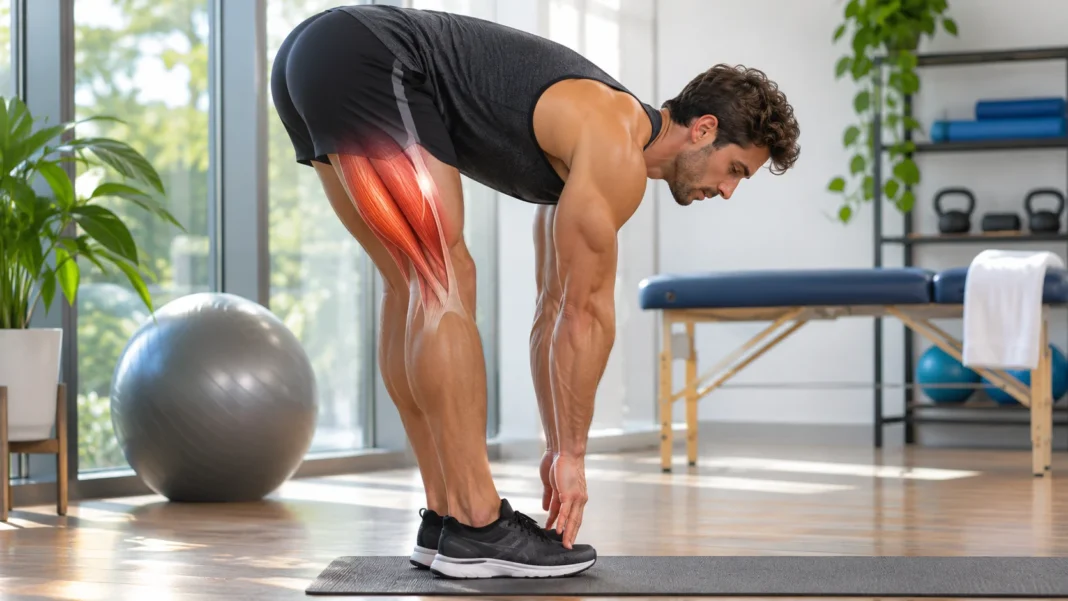


The hamstrings muscles are a group of important muscles located at the back of your thighs. They help you walk, run, bend your knees, and perform many everyday movements. These muscles also support hip movement, lower-body stability, and coordination during physical activities. Understanding their anatomy and function can help you appreciate how your legs work.
Although people often associate the hamstrings with athletic performance, these muscles are essential for everyone. They assist with movements such as climbing stairs, standing up, and changing direction. When the hamstrings become weak, injured, or unusually tight, certain movements may become uncomfortable or difficult.
This guide explains the hamstrings muscles, their anatomy, location, functions, and common injuries. You will also learn how these muscles work with other muscle groups, how strength and flexibility affect movement, and which exercises can support healthy hamstring function.
What Are the Hamstrings Muscles?
The hamstrings are a group of muscles located along the back of the thigh. They extend from the pelvis or thighbone toward the lower leg and play an important role in moving the hip and knee joints. The three main hamstring muscles are the biceps femoris, semitendinosus, and semimembranosus.
Most hamstring muscles cross both the hip and knee joints. This allows them to contribute to several movements rather than performing only one action. Their primary functions include bending the knee and extending the hip. These movements are essential during walking, running, lifting, and other everyday physical activities.
The hamstrings also help control the position of the lower body during movement. They work with the gluteal muscles, quadriceps, and other stabilizing muscles to coordinate motion. Healthy hamstring function depends on strength, flexibility, coordination, and the condition of surrounding joints and tissues.
Where Are the Hamstring Muscles Located?
The hamstrings are positioned in the posterior compartment of the thigh, which means the back portion of the upper leg. They run from the lower pelvis or thighbone toward the bones of the lower leg. Their location allows them to influence both hip movement and knee function.
Most hamstring fibers originate from the ischial tuberosity, a bony area at the bottom of the pelvis commonly called the sitting bone. Their tendons extend toward the tibia or fibula near the knee. However, the short head of the biceps femoris begins on the femur and crosses only the knee joint.
You may notice the hamstrings working when bending your knee or extending your leg backward at the hip. The muscles become active during many lower-body exercises and daily movements. Their anatomical position also explains why stretching the back of the thigh often involves changing both hip and knee positions.
The Three Main Hamstring Muscles Explained
The hamstrings consist of three primary muscles: the biceps femoris, semitendinosus, and semimembranosus. These muscles occupy different positions along the back of the thigh and attach to different structures near the knee. Although they work together during many movements, each has particular anatomical characteristics.
The biceps femoris is located more toward the outer side of the posterior thigh. The semitendinosus and semimembranosus are positioned toward the inner side. Their arrangement allows the group to assist with knee flexion, hip extension, and rotation of the lower leg when the knee is bent.
Understanding these individual muscles helps explain how the hamstrings function as a coordinated group. Differences in their attachments influence the movements they support. Although the muscles share important responsibilities, their activation can vary with joint position, exercise selection, and the specific movement being performed.
Biceps Femoris: Anatomy and Function
The biceps femoris is a hamstring muscle located along the outer portion of the back of the thigh. It has two heads, known as the long head and short head. These portions have different origins but join toward a common tendon that attaches primarily near the head of the fibula.
The long head originates from the ischial tuberosity and crosses both the hip and knee joints. The short head begins along the femur and crosses only the knee. This anatomical difference means the long head contributes to hip extension, while both heads assist with knee flexion.
The biceps femoris also helps rotate the lower leg outward when the knee is flexed. Its functions are important during walking, running, and movements involving changes in direction. Like other hamstring muscles, it works with surrounding muscles to provide coordinated movement rather than acting independently.
Semitendinosus: Anatomy and Function
The semitendinosus is a long, relatively narrow hamstring muscle positioned along the inner portion of the posterior thigh. It begins at the ischial tuberosity and extends downward toward the upper inner surface of the tibia. Its long tendon contributes to a group of attachments known as the pes anserinus.
This muscle assists with knee flexion and hip extension. It also contributes to inward rotation of the lower leg when the knee is bent. These functions help coordinate lower-body movement during activities such as walking, climbing stairs, and controlled changes in body position.
The semitendinosus works closely with the semimembranosus and other surrounding muscles. Its tendon may also be used in certain reconstructive surgical procedures, including some knee ligament operations. Understanding its location and function provides useful context for lower-body anatomy, rehabilitation, and exercise planning.
Semimembranosus: Anatomy and Function
The semimembranosus is a broad hamstring muscle located toward the inner and deeper portion of the posterior thigh. It originates from the ischial tuberosity and attaches primarily to the posterior portion of the medial tibial condyle. Its name reflects the broad, flattened tendon associated with its structure.
Like the semitendinosus, the semimembranosus contributes to hip extension and knee flexion. It also assists with inward rotation of the lower leg when the knee is bent. These movements help control the position of the leg during walking and other coordinated activities.
The semimembranosus contributes to stability and movement around the knee. Its anatomical relationships with nearby tendons and ligaments are relevant when assessing certain posterior knee problems. However, discomfort behind the knee does not automatically indicate an injury to this muscle because several other structures occupy the same region.
What Is the Main Function of the Hamstrings?
The main functions of the hamstrings are knee flexion and hip extension. Knee flexion occurs when the lower leg moves toward the back of the thigh, reducing the angle at the knee. Hip extension occurs when the thigh moves backward relative to the pelvis or the trunk returns from a forward-bent position.
Most hamstring muscles participate in both movements because they cross the hip and knee joints. The short head of the biceps femoris is an exception because it crosses only the knee. This distinction is important when considering muscle anatomy and how different exercises challenge the hamstring group.
The hamstrings also help control movement rather than simply producing it. During walking and running, they can work to slow or stabilize the leg at different points in the movement cycle. Their contribution changes according to joint position, movement speed, and coordination with other muscles.
How Hamstrings Help You Walk and Run
During walking, the hamstrings help control movement at the hip and knee. They become particularly important as the leg swings forward and prepares for contact with the ground. Their activity helps coordinate the position of the lower limb and supports a smooth transition between different phases of walking.
Running places greater demands on the hamstrings because the legs move more quickly and generate higher forces. During the late swing phase, the hamstrings help slow the forward movement of the lower leg. They also contribute to hip extension and lower-body control during other portions of the running cycle.
These functions explain why hamstring conditioning is relevant to running and athletic training. However, stronger hamstrings alone do not guarantee better performance or prevent every injury. Overall strength, running demands, coordination, recovery, and individual movement characteristics all influence how the muscles respond to physical activity.
How Hamstrings Work With the Quadriceps
The hamstrings and quadriceps perform different but coordinated actions around the knee. The quadriceps are located along the front of the thigh and primarily extend the knee. The hamstrings are located behind the thigh and primarily flex the knee. Together, these muscle groups contribute to controlled lower-body movement.
During activities such as walking, squatting, and standing up, both groups can be active at different moments. The quadriceps help extend the knee, while the hamstrings assist with hip extension and control certain aspects of knee movement. Their roles vary depending on the position and demands of the activity.
A balanced exercise program should generally include movements that strengthen both muscle groups. However, there is no universal strength ratio that guarantees injury prevention or optimal performance. Individual needs depend on physical abilities, activity levels, and medical history. Comfortable, progressive training is usually more useful than focusing on one muscle group alone.
Why Hamstring Flexibility Matters
Hamstring flexibility refers to the ability of the muscles and surrounding tissues to accommodate movement through a comfortable range. Adequate flexibility can support activities involving hip bending and knee movement. However, the amount of flexibility needed varies depending on a person’s anatomy, daily activities, and physical goals.
People sometimes describe their hamstrings as tight when they experience tension along the back of the thigh. This sensation can have several explanations, including muscle stiffness, reduced movement tolerance, or irritation involving other tissues. It does not always mean the muscle is physically shortened.
Gentle stretching and appropriate movement exercises may help improve comfort and range of motion. However, stretching should not cause sharp pain, tingling, or increasing discomfort. People with persistent symptoms should avoid assuming that more stretching is always the solution. A qualified healthcare professional can help identify the underlying cause.
Common Causes of Hamstring Tightness
Hamstring tightness can develop for different reasons, including prolonged inactivity, changes in exercise demands, or temporary muscle stiffness. People who spend long periods sitting may notice tension when standing or bending forward. However, sitting does not automatically cause permanent hamstring shortening.
Physical activity can also influence how the hamstrings feel. Unfamiliar exercises, running, and demanding lower-body movements may produce temporary soreness or stiffness. These sensations often improve with suitable recovery. However, persistent discomfort may indicate a problem requiring further assessment rather than ordinary post-exercise soreness.
In some cases, sensations resembling hamstring tightness may involve the sciatic nerve or other structures. Tingling, numbness, or pain extending below the knee may suggest a different issue. Because symptoms can overlap, self-diagnosis is not always reliable. Professional evaluation may be appropriate when symptoms persist or affect normal activity.
Common Hamstring Injuries and Problems
Hamstring strains are among the most familiar injuries affecting the back of the thigh. They occur when muscle fibers or the muscle-tendon unit are injured under excessive loading. These injuries are often associated with running and other activities requiring rapid or forceful lower-body movements.
Hamstring problems can also involve tendons rather than the muscle itself. Proximal hamstring tendinopathy affects the tendon region near the sitting bone and may cause discomfort during certain activities. Other sources of posterior thigh pain include nerve-related conditions, referred pain, and injuries involving nearby structures.
Symptoms and treatment needs vary depending on the underlying condition. Mild muscle soreness is different from a significant strain or persistent tendon problem. Sudden severe pain, substantial weakness, or difficulty walking deserves medical attention. Accurate diagnosis is important because different conditions may require different recovery approaches.
Signs and Symptoms of a Hamstring Strain
A hamstring strain may cause sudden pain along the back of the thigh during physical activity. Some people experience tenderness, stiffness, or difficulty moving comfortably afterward. The severity can vary considerably depending on the injury. Symptoms alone do not establish the exact extent of muscle damage.
More significant injuries may produce noticeable weakness, swelling, or bruising. Walking, bending the knee, or extending the hip may become uncomfortable. However, similar symptoms can occur with other conditions. A healthcare professional may assess muscle function, tenderness, and movement to determine whether additional investigation is necessary.
Avoid continuing demanding exercise when a hamstring injury is suspected. Pushing through pain can aggravate the problem and delay appropriate recovery. Significant weakness, inability to walk normally, or severe symptoms should be assessed promptly. A suitable rehabilitation plan depends on the diagnosis and the individual’s functional needs.
Best Exercises for Strengthening Hamstrings
Hamstring strengthening exercises help improve the muscles’ capacity to produce and control force. Common options include hamstring curls, hip bridges, and appropriately selected hip-hinge movements. Each exercise challenges the muscles differently. A balanced program can combine knee-flexion and hip-extension exercises because both functions are important.
Hamstring curls emphasize knee flexion, while bridges train hip extension with assistance from the gluteal muscles. More demanding movements may involve greater resistance or controlled muscle lengthening. However, exercise selection should reflect current abilities and comfort. Beginners often benefit from simpler movements before progressing to more challenging variations.
Gradual progression is an important part of strengthening the hamstrings. Increasing exercise difficulty too quickly may create unnecessary soreness or strain. Adequate recovery and attention to technique support consistent training. People with recent injuries or persistent symptoms should follow individualized rehabilitation advice rather than relying on general strengthening recommendations.
Hamstring Curls: Benefits and Proper Form
Hamstring curls are exercises that primarily target knee flexion. They can be performed using different forms of resistance, including certain exercise machines or light resistance bands. These movements provide a focused way to strengthen muscles along the back of the thigh while practicing controlled knee movement.
For a simple standing variation, stand beside a stable support and maintain a comfortable posture. Slowly bend one knee to bring the heel toward the back of the thigh, then lower the foot with control. Avoid excessive movement through the hips or lower back. The exercise should remain smooth and comfortable.
Begin with a manageable range of motion and avoid forcing the knee into uncomfortable positions. Additional resistance may be appropriate as strength improves, but correct technique should remain the priority. Stop if the exercise causes sharp pain or unusual symptoms. Recent hamstring injuries may require a modified approach under professional guidance.
Glute Bridges for Hamstring and Hip Strength
Glute bridges are commonly used to strengthen the muscles responsible for hip extension. Although the gluteal muscles perform a major role, the hamstrings also contribute to the movement. This makes bridges a useful addition to general lower-body conditioning when performed with appropriate technique and comfort.
Begin by lying on your back with your knees bent and feet resting on the floor. Gently lift your hips until your trunk and thighs form a comfortable alignment. Pause briefly before lowering with control. Avoid excessively arching the lower back or pushing beyond a comfortable range of motion.
Bridges can be adjusted according to individual strength and experience. However, more difficult variations are not automatically better. A basic bridge performed comfortably may be appropriate for many beginners. If you experience back pain, hamstring cramping, or other discomfort, modify the movement or consult a qualified exercise or rehabilitation professional.
Romanian Deadlifts and Hamstring Function
Romanian deadlifts are hip-hinge exercises that challenge the hamstrings and other muscles involved in controlling hip movement. The hamstrings contribute as the hips move backward and the trunk inclines forward. This exercise can improve lower-body strength when performed with suitable resistance and careful technique.
A basic hip-hinge movement involves slightly bending the knees while moving the hips backward and keeping the spine comfortably aligned. The movement should come primarily from the hips rather than excessive spinal rounding. Beginners can first practice the pattern without added weight to understand how their body moves.
Loaded variations require appropriate instruction, especially for people unfamiliar with strength training. Excessive resistance or uncontrolled movement may increase injury risk. The exercise should not produce sharp pain or unusual pulling sensations. A qualified trainer or physical therapist can help determine whether this movement is suitable for your abilities and goals.
Gentle Hamstring Stretches for Flexibility
Gentle stretching can help some people improve hamstring movement tolerance and flexibility. A seated hamstring stretch is one accessible option that requires little equipment. Stretching should create mild tension rather than pain. The objective is controlled movement within a comfortable range, not reaching a particular position.
Sit on a stable surface with one leg extended comfortably and the other positioned for support. Keeping your back in a comfortable alignment, gently hinge forward from the hips until you notice a mild stretch behind the thigh. Avoid bouncing or forcing the movement. Return slowly to the starting position.
Other variations include supine hamstring stretches performed while lying on the back. Different positions may feel more comfortable depending on mobility and individual needs. If stretching produces tingling, numbness, or sharp discomfort, stop the activity. People with recent injuries should obtain appropriate guidance before beginning a stretching routine.
How to Improve Hamstring Strength and Flexibility Safely
Improving hamstring function involves balancing strengthening, mobility, and recovery. Strength training helps develop the muscles’ ability to handle force, while comfortable mobility exercises support movement through useful ranges. Both approaches can complement everyday physical activity. The appropriate balance depends on individual goals and current physical abilities.
A practical routine may include simple hamstring curls, bridges, and gentle stretching on suitable days. Other lower-body activities can help maintain general strength and coordination. However, performing every exercise in one session is unnecessary. Starting with manageable activities and progressing gradually can make training easier to maintain.
Pay attention to how your body responds to exercise. Temporary muscle fatigue may be expected, but persistent pain or worsening symptoms suggest that adjustments are needed. Rest and recovery remain important parts of physical conditioning. Individuals recovering from injury should prioritize their clinician’s recommendations over general exercise advice.
When Should You See a Doctor for Hamstring Pain?
Hamstring discomfort does not always require medical treatment, particularly when it involves mild temporary soreness after unfamiliar exercise. However, sudden severe pain, significant weakness, or difficulty walking may indicate a more serious injury. These symptoms deserve prompt assessment rather than continued strenuous activity.
Persistent pain near the sitting bone or along the back of the thigh may involve tendons, nerves, or other structures. Symptoms such as numbness, tingling, or radiating pain can suggest conditions beyond a simple muscle problem. A healthcare professional can examine the symptoms and determine whether further investigation is necessary.
Early assessment may help identify an appropriate treatment and rehabilitation plan. Physical therapists can also evaluate strength, flexibility, and functional movement when required. Seeking advice is especially important when symptoms repeatedly return or interfere with normal daily activities. The goal is safe recovery and comfortable long-term movement.
Conclusion
The hamstrings muscles are essential for knee flexion, hip extension, and coordinated lower-body movement. The biceps femoris, semitendinosus, and semimembranosus work together to support walking, running, and everyday activities. Their location along the back of the thigh allows them to influence both movement and control around the hip and knee.
Healthy hamstring function depends on more than flexibility alone. Strength, coordination, activity demands, and recovery all contribute to how these muscles perform. Appropriate strengthening exercises and gentle mobility work can support general lower-body fitness. However, persistent pain or unexplained weakness should not be treated through exercise alone.
Understanding hamstring anatomy makes it easier to recognize the importance of balanced lower-body conditioning. Whether you are interested in everyday mobility or general fitness, learning how these muscles work can support better exercise decisions. A gradual, comfortable approach helps maintain useful movement while reducing unnecessary strain.
Frequently Asked Questions
What Are the Three Main Hamstring Muscles?
The three main hamstring muscles are the biceps femoris, semitendinosus, and semimembranosus. They are located at the back of the thigh and primarily help bend the knee and extend the hip.
What Is the Main Function of the Hamstrings?
The hamstrings primarily perform knee flexion and hip extension. They also help control leg movement during walking and running, contributing to lower-body coordination and stability.
Where Are the Hamstrings Located?
The hamstrings are located along the back of the upper leg, extending from the pelvis or thighbone toward the lower leg. Most of these muscles cross both the hip and knee joints.
What Causes Tight Hamstring Muscles?
Hamstring tightness may relate to temporary muscle stiffness, physical activity, reduced movement tolerance, or other conditions. Persistent tightness accompanied by pain, tingling, or weakness may require professional evaluation.
What Exercises Strengthen the Hamstring Muscles?
Common hamstring strengthening exercises include hamstring curls, glute bridges, and suitable hip-hinge movements. The appropriate exercises depend on your experience, comfort, and any existing injuries or physical limitations.