


What Are Deltoid Exercises?
Deltoid exercises are movements designed to strengthen the shoulder muscles responsible for lifting, rotating, and stabilizing your arms. The deltoids cover the outer shoulder and contribute to everyday activities such as reaching overhead, carrying objects, and pushing doors. Training these muscles can improve shoulder strength, movement control, and overall upper-body function.
The deltoid muscle has three main sections: anterior, lateral, and posterior. Each section contributes to different movements, although they frequently work together during exercise. A balanced shoulder workout includes movements that engage all three sections while supporting comfortable joint movement and proper exercise technique.
You can perform many deltoid exercises using dumbbells, resistance bands, cable machines, or simple bodyweight movements. Beginners should focus on learning controlled movement patterns before increasing resistance. With appropriate technique, recovery, and gradual progression, shoulder exercises can become a useful part of a well-rounded fitness routine.
Understanding the Three Parts of the Deltoid Muscle
The anterior deltoid sits at the front of your shoulder and helps lift your arm forward. It also contributes to certain pushing and rotational movements. Exercises such as overhead presses and front raises involve this muscle, although the amount of activation depends on the exercise and how you perform it.
The lateral deltoid forms the middle section of the shoulder and contributes to raising your arm sideways. Lateral raises are commonly used to train this movement. The muscle also works alongside other shoulder structures to support arm movement during daily activities and resistance exercises.
The posterior deltoid is located at the back of your shoulder and contributes to moving your arm backward and outward. Reverse fly movements and certain rowing exercises involve this section. Understanding the three deltoid regions helps you choose balanced exercises without placing unnecessary emphasis on a single shoulder movement.
Why Deltoid Exercises Are Important
Strong deltoid muscles support many everyday activities that involve your shoulders and upper arms. Reaching shelves, lifting lightweight objects, and moving your arms in different directions all require coordinated shoulder movement. Regular strengthening exercises can help improve the muscular capacity needed for these familiar tasks.
Shoulder exercises also contribute to upper-body strength when included in a balanced resistance training program. The deltoids work alongside the rotator cuff, trapezius, serratus anterior, and other muscles that influence shoulder movement. Training these structures together can support better movement control during pushing, pulling, and overhead activities.
Another benefit of deltoid training is improved confidence when performing upper-body exercises. Learning how to control your shoulders under manageable resistance builds useful movement skills. However, strength training should progress gradually, especially if you are new to exercise or have experienced shoulder discomfort in the past.
How to Warm Up Before Deltoid Exercises
A proper warm-up prepares your shoulders for movement and helps you become comfortable with the exercises ahead. Begin with gentle activities such as walking or marching in place to increase overall body temperature. Follow this with controlled arm movements that gradually take your shoulders through comfortable ranges of motion.
Arm circles are a simple warm-up exercise that requires no equipment. Stand comfortably and make small circles with your arms before gradually increasing the movement size. Keep the motion smooth and avoid forcing your shoulders into uncomfortable positions, particularly if you notice stiffness or restricted movement.
You can also practice light resistance band movements or perform your planned exercises without added weight. These movements provide an opportunity to check your posture and coordination before beginning harder sets. A warm-up should leave your shoulders feeling prepared rather than tired, sore, or irritated.
Dumbbell Shoulder Press: How to Do It Correctly
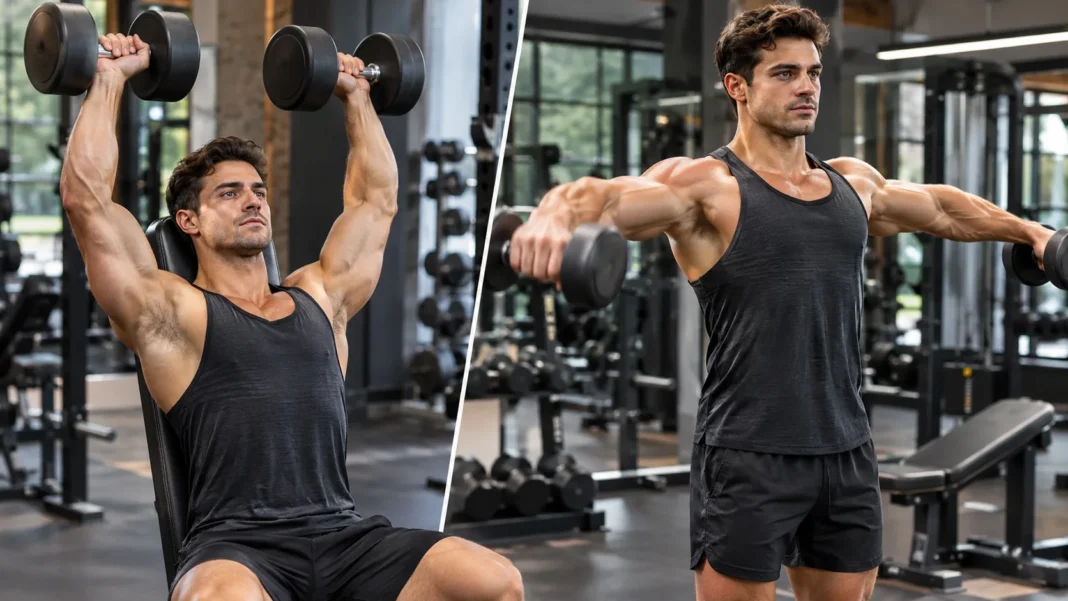
The dumbbell shoulder press is a compound exercise that strengthens the deltoids and involves several supporting muscles. It primarily challenges the front and middle portions of the shoulders while engaging the triceps. You can perform this movement while seated or standing, depending on your experience, comfort, and available equipment.
Begin by holding a pair of manageable dumbbells near shoulder height with your palms facing forward or slightly inward. Press the weights upward through a comfortable range of motion while maintaining a stable torso. Lower the dumbbells slowly toward the starting position without allowing your back to arch excessively.
Keep your breathing steady and avoid using sudden momentum to move the weights. A lighter resistance is often preferable when learning the movement because it allows better control. If overhead pressing causes shoulder pain, stop the exercise and consider a comfortable alternative rather than pushing through the discomfort.
Dumbbell Lateral Raises for the Middle Deltoids
Dumbbell lateral raises are popular shoulder strengthening exercises that primarily target the lateral deltoid. The movement involves raising your arms outward to the sides while holding light weights. Because the shoulders perform a relatively isolated movement, controlling the resistance is more important than using heavy dumbbells.
Stand with your feet comfortably apart and hold a dumbbell in each hand. Keep your elbows slightly bent as you lift your arms outward toward shoulder height. Pause briefly if comfortable, then lower the weights slowly while maintaining control throughout the entire movement.
Avoid swinging your arms or shrugging your shoulders excessively to lift the dumbbells. If the weights require substantial momentum, reduce the resistance and concentrate on smooth technique. You can also perform lateral raises one arm at a time, which may make it easier to focus on movement control.
Front Raises for Anterior Deltoid Strength
Front raises are simple exercises that emphasize the anterior portion of the deltoid muscle. They involve lifting your arms forward against resistance and can be performed with dumbbells or resistance bands. This movement may complement a shoulder routine, although front deltoids already receive considerable work during many pressing exercises.
Start in a comfortable standing position while holding light dumbbells in front of your thighs. Raise one or both arms forward to approximately shoulder height, keeping your elbows slightly bent. Slowly return to the starting position without swinging your upper body or using excessive momentum.
Maintain a neutral spine and relaxed neck throughout the exercise. Avoid lifting the weights higher than your comfortable shoulder range or forcing the movement when discomfort develops. Since front raises can overlap with overhead pressing, they are optional rather than essential for every shoulder training program.
Reverse Fly Exercises for Rear Deltoids
Reverse fly exercises emphasize the posterior deltoids and other muscles involved in upper-back movement. They are commonly performed with dumbbells, resistance bands, or cable machines. Including rear shoulder movements can help create a balanced training routine that does not rely entirely on pressing exercises.
To perform a bent-over dumbbell reverse fly, hold light weights and hinge forward comfortably at your hips. Keep your back in a stable position and allow your arms to hang beneath your shoulders. Raise your arms outward with slightly bent elbows before returning slowly to the starting position.
Focus on controlled movement rather than lifting the heaviest possible weights. Avoid throwing your torso upward or relying on momentum to complete repetitions. If bending forward feels uncomfortable, a supported chest position or resistance band variation may provide a more manageable alternative.
Arnold Press: A Shoulder Exercise Variation
The Arnold press is a variation of the dumbbell shoulder press that includes a controlled arm rotation. It challenges the deltoids and supporting muscles through a changing shoulder position. Although some people enjoy this variation, it is not necessary for developing shoulder strength and may feel uncomfortable for certain individuals.
Begin in a seated or standing position with manageable dumbbells positioned in front of your shoulders. Your palms generally face toward your body at the starting position. As you press upward, gradually rotate your palms outward, then reverse the movement while returning the weights toward shoulder height.
Move slowly and avoid forcing your shoulders through a range that feels restricted. The additional rotation requires coordination, making this exercise more suitable after learning a standard shoulder press. If the movement produces pinching or discomfort, choose a simpler pressing variation that allows comfortable shoulder mechanics.
Resistance Band Deltoid Exercises for Beginners
Resistance bands provide a convenient option for performing deltoid exercises without heavy gym equipment. They are lightweight, portable, and available in different resistance levels. Band exercises can help beginners practice controlled shoulder movements at home, although resistance changes as the band stretches.
Band lateral raises are one useful option for targeting the middle deltoids. Secure the band according to its design and pull outward through a comfortable movement range. Keep your shoulders relaxed and avoid sudden movements that cause the band to snap back or place unnecessary stress on your joints.
Resistance bands can also be used for front raises, reverse fly variations, and certain external rotation exercises. Choose a resistance level that allows steady control without excessive strain. Inspect the band for damage before use and ensure it is securely positioned to reduce the risk of accidental release.
Bodyweight Deltoid Exercises Without Equipment
Bodyweight shoulder exercises allow you to strengthen the upper body without purchasing additional equipment. Certain wall push-up variations and supported weight-bearing movements engage the deltoids along with other muscles. These exercises are particularly useful when you want to practice shoulder control in a familiar environment.
Wall push-ups are a manageable starting point for many beginners. Stand facing a wall, place your hands at a comfortable height, and slowly bend your elbows while moving your body toward the surface. Press back to the starting position while keeping your torso aligned and avoiding unnecessary shoulder tension.
As your strength and coordination improve, you can explore appropriately challenging floor-based variations. However, advanced movements such as handstand push-ups require substantial preparation and are not suitable starting exercises. Choose activities that match your current abilities and allow you to maintain steady, pain-free control.
Cable Deltoid Exercises at the Gym
Cable machines provide adjustable resistance and allow different shoulder exercise variations. They are commonly used for lateral raises, front raises, and rear deltoid fly movements. The cable’s direction and attachment position influence how the muscles are challenged throughout each exercise.
For a cable lateral raise, position the pulley according to the equipment instructions and select a manageable weight. Hold the handle securely and raise your arm outward through a comfortable range. Lower the handle slowly while keeping your torso stable and avoiding sudden movements that disturb your balance.
Cable reverse fly movements can also help train the posterior deltoids. Proper positioning is important because incorrect cable height or resistance may encourage awkward shoulder mechanics. If you are unfamiliar with a machine, ask a qualified gym instructor to demonstrate safe setup and technique before beginning.
How Many Sets and Reps Should You Do?
The appropriate number of sets and repetitions depends on your experience, training goals, and overall workout routine. Beginners can often start with one or two controlled sets of an exercise using light resistance. The main priority should be learning comfortable movement patterns rather than reaching a particular repetition target.
A practical starting range for many shoulder exercises is approximately eight to twelve repetitions per set. However, this is not a strict requirement, and lighter resistance may allow more controlled repetitions. Stop when technique begins to deteriorate, and avoid continuing if you experience sharp pain or unusual joint discomfort.
Shoulder training should also include sufficient recovery between demanding sessions. Your deltoids are involved in many pushing and pulling exercises, so additional isolation work may not always be necessary. Gradually adjusting training volume according to comfort, progress, and recovery is generally more useful than following an overly demanding schedule.
Common Mistakes to Avoid During Deltoid Exercises
Using excessive weight is one of the most common mistakes people make during deltoid exercises. Heavy resistance can encourage swinging, shrugging, and unnecessary movement through the torso. Choosing manageable weights allows you to concentrate on technique and maintain more consistent control during each repetition.
Another mistake is performing only exercises that emphasize the front of the shoulders. Many popular pushing movements already involve the anterior deltoids, while posterior shoulder training may receive less attention. Including appropriate pulling and rear deltoid movements helps create a more balanced approach to upper-body strengthening.
Ignoring discomfort or rushing through repetitions can also make shoulder training less effective. The shoulder is a complex joint that requires coordinated movement from several muscles. Avoid forcing uncomfortable ranges, and seek professional guidance if pain continues or repeatedly interferes with normal activities.
How to Build a Balanced Deltoid Workout
A balanced deltoid workout includes exercises that challenge different shoulder movements without creating unnecessary fatigue. One practical approach combines a shoulder press, a lateral raise, and a rear deltoid exercise. This selection provides variety while keeping the routine simple enough for beginners to understand and perform.
For example, you might begin with controlled dumbbell shoulder presses before moving to lighter lateral raises. Finish with reverse fly movements that emphasize the back of the shoulders. Choose manageable resistance and adjust repetitions according to your ability rather than trying to complete every exercise at maximum effort.
You should also consider how shoulder exercises fit into your existing upper-body workouts. Chest presses, rows, and other compound movements already involve the deltoids to varying degrees. Coordinating these exercises can help you maintain balanced training and avoid performing more shoulder work than you can comfortably recover from.
Deltoid Exercises for Better Shoulder Stability
Shoulder stability depends on coordinated activity between the deltoids, rotator cuff, shoulder blade muscles, and surrounding tissues. Although the deltoids contribute to arm control, they are not responsible for stability alone. A complete shoulder routine should therefore include movements that support the broader muscular system around the joint.
Controlled wall push-ups, light external rotation exercises, and appropriate resistance band movements can help develop coordination. These exercises may be useful alongside traditional deltoid strengthening activities. The goal is to practice stable, comfortable movement rather than placing excessive resistance on the shoulder joint.
People recovering from shoulder injuries may require individualized exercises rather than a standard gym routine. Certain movements can aggravate existing conditions if performed too early or with unsuitable resistance. A qualified healthcare professional can help determine appropriate exercises when pain, weakness, or restricted shoulder movement is present.
How to Progress Safely With Deltoid Exercises
Progressive training involves gradually increasing the challenge as your muscles become more comfortable with an exercise. This might include improving movement control, adding repetitions, or increasing resistance slightly. Progress should reflect consistent technique and recovery rather than pressure to achieve rapid changes.
Before increasing difficulty, make sure you can complete your current exercises without unnecessary swinging or loss of control. Smooth repetitions and comfortable shoulder movement are useful signs that your chosen resistance is manageable. If a new weight makes your technique noticeably worse, returning to a lighter option is reasonable.
Recovery is also an important part of developing strength and maintaining comfortable movement. Sleep, regular meals, and appropriate rest support the body’s normal adaptation to physical activity. A gradual approach allows you to build skills over time while reducing unnecessary strain and maintaining a sustainable exercise routine.
When Should You Avoid Deltoid Exercises?
Deltoid exercises may need to be modified or temporarily avoided when shoulder movement causes significant pain. Recent injuries, unexplained weakness, swelling, or restricted range of motion can indicate that professional assessment is necessary. Exercising through these symptoms may make it harder to identify and address the underlying problem.
People with existing shoulder conditions should follow personalized guidance from a qualified healthcare professional. Some exercises may remain appropriate, while others require adjustments to resistance or movement range. The right approach depends on the condition, current symptoms, and individual rehabilitation goals.
Mild muscular fatigue after unfamiliar exercise can occur, but sharp joint pain is not something to ignore. Stop the movement if it produces sudden discomfort, numbness, or unusual weakness. Seeking medical advice for persistent or worsening symptoms helps ensure that shoulder training remains appropriate for your circumstances.
Conclusion
Deltoid exercises are useful for strengthening the shoulders and improving upper-body movement control. The anterior, lateral, and posterior deltoids contribute to different arm movements and everyday activities. Including a balanced selection of shoulder exercises can help support practical strength without relying on complicated workout routines.
Dumbbell presses, lateral raises, reverse fly movements, and resistance band exercises offer several ways to train the deltoids. The most important factors are manageable resistance, controlled technique, and comfortable movement. Beginners can start with simple exercises and gradually develop confidence as their coordination and strength improve.
Building stronger shoulders requires consistency, appropriate recovery, and attention to individual comfort. Avoid rushing progress or pushing through persistent joint pain. With thoughtful exercise selection and steady practice, deltoid training can become a beneficial part of a balanced fitness program.
Frequently Asked Questions
What are the best deltoid exercises for beginners?
Dumbbell shoulder presses, light lateral raises, reverse fly exercises, and resistance band movements are useful beginner options. Start with manageable resistance and focus on comfortable technique rather than lifting heavy weights.
Can I train all three deltoid muscles in one workout?
Yes, a balanced shoulder workout can include movements targeting the anterior, lateral, and posterior deltoids. Combining shoulder presses, lateral raises, and reverse fly exercises provides a straightforward approach.
How often should I perform deltoid exercises?
Many beginners can include shoulder strengthening exercises in their routine two or three times weekly with suitable recovery. The appropriate frequency depends on total training volume, exercise intensity, and individual comfort.
Can I strengthen my deltoids without dumbbells?
Yes, resistance bands, wall push-ups, and other appropriate bodyweight exercises can strengthen the shoulders. Choose movements that match your current ability and allow controlled, comfortable technique throughout each repetition.
Should deltoid exercises cause shoulder pain?
Deltoid exercises should not cause sharp or persistent shoulder pain. Mild muscular effort is expected, but unusual discomfort may indicate unsuitable technique or an underlying problem requiring professional assessment.