


What Are Commercial UV Water Treatment Systems?
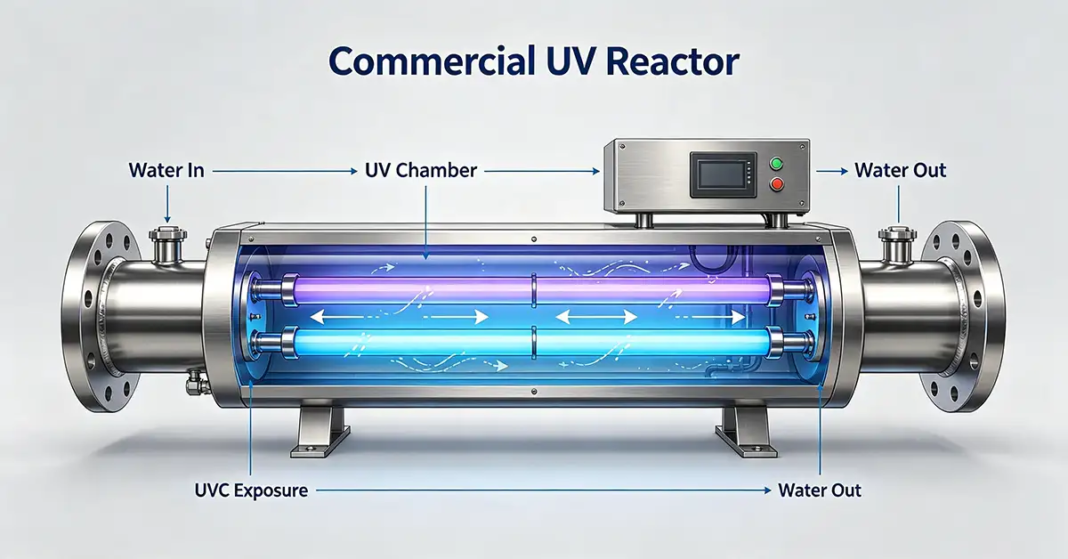
Commercial UV water treatment systems apply UV light to treat running water.
They are intended for facilities which have increased water demands in comparison with standard home needs.
Typical users include:
- Restaurants
- Hotels
- Schools
- Farms
- Food factories
- Breweries
- Offices
- Campgrounds
- Hospitals
- Laboratories
- Commercial buildings
- Light industrial plants
Traditionally, most systems use germicidal UVC light with wavelength close to 254nm.
Water is treated inside the UV chamber.
The UV light is applied to the microorganisms contained in the water thus preventing their reproduction.
The UV treatment is provided without addition of any disinfecting chemical to the water.
According to EPA guidelines, UV is recognized as a technology for treating drinking water and is appreciated for the ability to control pathogens including Cryptosporidium.
How Does Commercial UV Water Treatment Work?
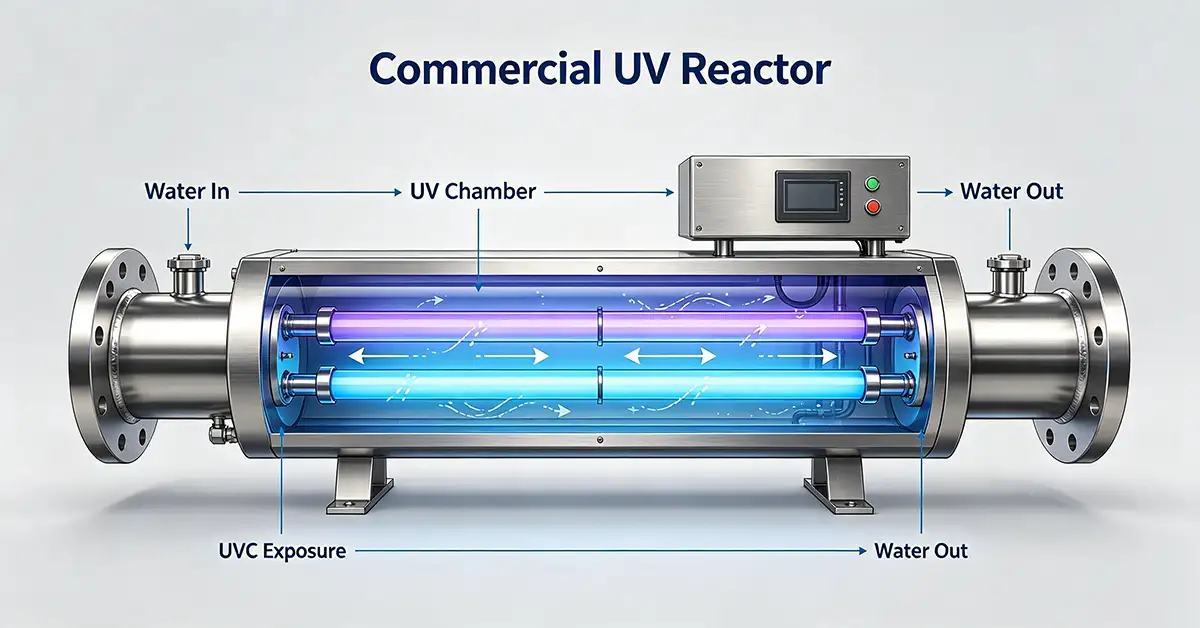
The principle of the UV water treatment is quite simple.
Water is applied to the stainless-steel UV chamber.
The chamber contains one or several UV lamps.
The quartz sleeve is traditionally placed between the lamp and the water to separate them.
The lamp provides UVC energy that passes through the quartz and is applied to the water.
The microorganisms are treated with the UV energy while passing through the reactor.
The UV energy prevents the microorganisms from reproduction.
Water leaves the chamber.
Thus, there is no need to store any disinfecting chemical or apply it during the UV step.
However, the successful operation of the system is more complicated than turning on the UV lamp.
The factors like the flow rate, the UV intensity, the water quality, the UV transmittance, the reactor design and the lamp condition should be considered.
The performance of the UV reactors is evaluated with validated operating conditions according to EPA guidance.
What Can UV Water Treatment Control?
The properly designed UV treatment system can be applied to treat many waterborne microorganisms.
These can include:
- Bacteria
- Some viruses
- Giardia
- Cryptosporidium
- Other UV-sensitive microorganisms
According to NSF, Class A UV microbiological treatment systems are designed to treat water potentially containing bacteria, viruses and cysts.
However, the UV treatment is mainly the microbial treatment step.
It should not be considered as the filter for all water problems.
What Does UV Water Treatment Not Remove?
It is a popular misconception.
The UV reactor is not a sediment filter, a carbon filter or a reverse osmosis membrane.
Standard UV disinfection does not remove:
- Sand
- Dirt
- Rust
- Hardness minerals
- Salt
- Heavy metals
- PFAS
- Pesticides
- Most dissolved chemicals
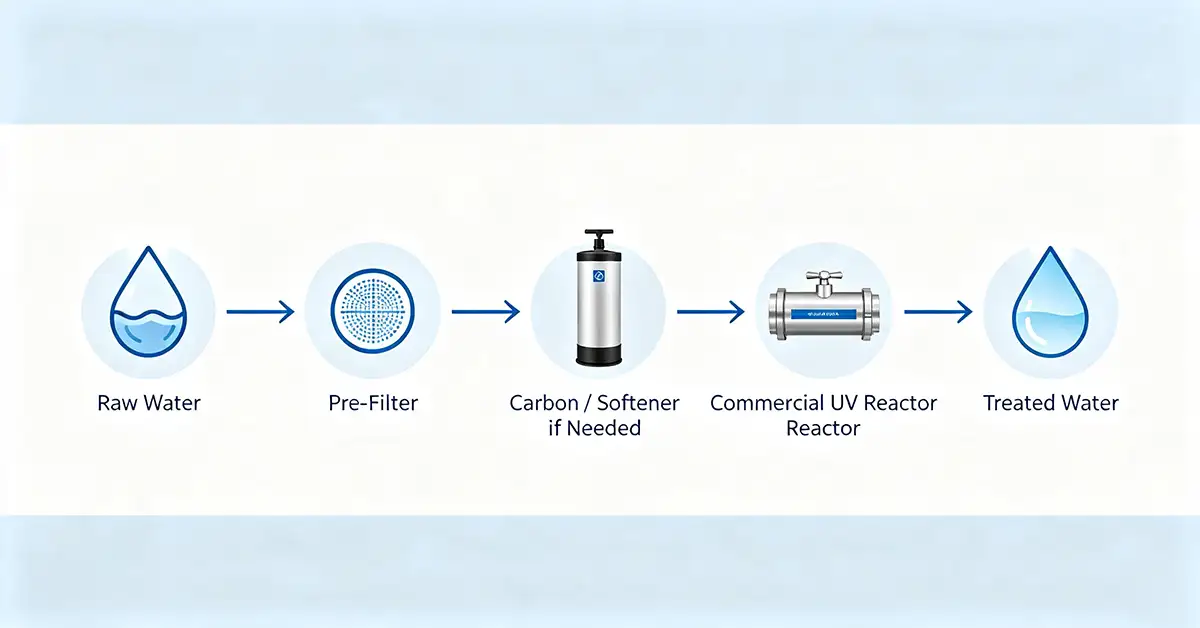
That is why commercial UV water treatment systems are often applied as one of the steps in the treatment chain.
For example:
Water Source → Sediment Filter → Carbon / Other Treatment → UV → Distribution
The exact design depends on the water test and the water-quality goal.
The Most Important Number Is Not Only Flow Rate
Most buyers start with this question:
How many gallons per minute do I need?
The flow rate is very important.
But the flow rate alone is not enough.
Why?
Two businesses can have similar demand – 50 GPM – and still need different UV systems.
Why?
Because the water of these businesses can have different UV transmittance.
Also, the target UV dose can be different.
The reactor design, the lamp output, the water temperature, the validation requirement – all these factors can change the size of the system.
The good commercial UV system should be selected based on the worst expected operating conditions not on the usual daily flow only.
What Is UVT?
UVT stands for UV Transmittance.
It indicates the ability of UV light to pass through water.
The higher the UVT, the more UV light is able to pass through the water.
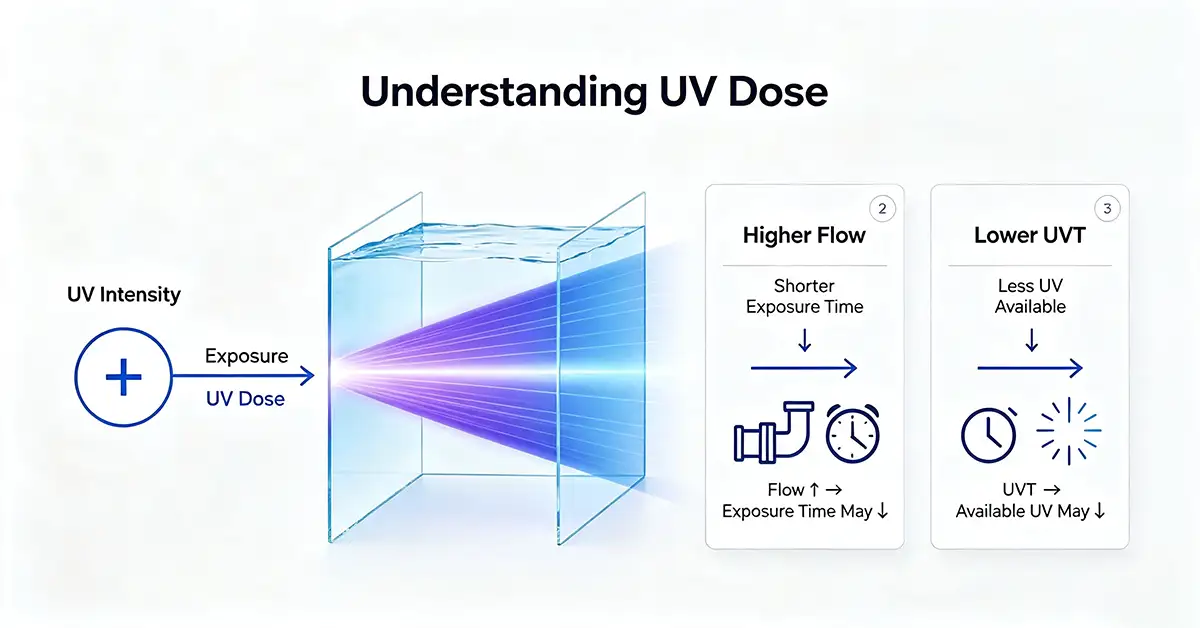
If the UVT is low, more UV energy will be absorbed in water before reaching the target microorganisms.
UVT and turbidity are not the same.
Water can be clear but still contain the substances absorbing UV light.
That is why commercial projects may need the UVT test instead of the visual test.
The UVT is one of the operating conditions in designing and validating the UV treatment system.
UVT vs Turbidity
These two characteristics are often confused.
UVT
UVT shows how much UV light can pass through the water.
Turbidity
Turbidity shows how turbid the water is due to the suspended particles.
Both the characteristics influence the UV treatment.
But they measure different properties.
For the commercial projects, the water analysis can help detect iron, manganese, hardness, color, organic matter and other issues affecting the treatment.
What Is UV Dose?
The UV dose is the amount of the UV energy applied to the water during the UV treatment.
It is traditionally expressed in:
mJ/cm²
The UV dose is connected to the UV intensity and exposure.
Higher numbers do not always mean that each system is better.
The required dose depends on:
- Treatment target
- Target microorganism
- Regulations
- Reactor validation
- Water quality
- Application
Therefore, commercial UV systems should be compared not only by lamp wattage but also by the validated treatment performance.
Why Lamp Wattage Alone Can Be Deceptive
You may come across systems indicated as:
- 40W
- 80W
- 120W
- 200W
These numbers are useful.
But they do not give the whole picture.
The electrical power of the lamp is not equal to the UV dose received by water.
The commercial buyer should take into account:
- Rated flow
- Design UVT
- Validated UV dose
- UV intensity monitoring
- Lamp type
- Lamp quantity
- Reactor design
- Maximum pressure
- Water temperature range
- Connection size
It will make it much easier to compare the two systems.
How to Size Commercial UV Water Treatment Systems
Start with the peak flow, not the average flow.
Think about the hotel.
Even though the average water consumption of the hotel across the full day is not very high.
In the morning hours, many showers, sinks, kitchens and cleaning lines work simultaneously.
This peak is very important.
Your commercial UV reactor should provide the required treatment even when the flow is at the highest design level.
Step 1: Determine Peak Flow
Use:
- Flow meter
- Plumbing design data
- Pump data
- Fixture calculations
- Historical water-use data
Do not size the system basing on the average daily water consumption.
Step 2: Test the Water
Useful tests may include:
- UVT
- Turbidity
- Iron
- Manganese
- Hardness
- pH
- Microbiological testing
Additional tests depend on the water source and the project.
Step 3: Set the Treatment Goal
Ask yourself:
- Drinking water?
- Process water?
- Food production water?
- Reuse water?
- Well water?
- RO product water?
- Cooling water?
The goal will define the system design.
Step 4: Check the Local Requirements
Commercial water requirements differ from region to region.
The restaurant, the public water system, the food plant and the private factory may have different requirements.
Contact the local authority or the project engineer before selecting the final equipment.
Step 5: Select Validated Operating Range
For the regulated drinking-water projects, the system may need to be operated within tested or validated limits for the flow, UVT, UV intensity and other operating conditions.
According to the EPA guidance, for public water systems, great importance is attached to the UV reactor validation and the operation within validated limits.
Do Commercial UV Systems Require Pre-filtration?
Very often, yes.
The UV light works effectively when it can move through the water.
The particles and the deposits can negatively influence the performance.
The pretreatment can include:
- Sediment filtration
- Iron removal
- Manganese removal
- Water softening
- Activated carbon
- Reverse osmosis
- Ultrafiltration
Not each step is necessary for each project.
Use the water test results to choose the correct pretreatment.
Example Treatment Line
For some well-water projects:
Well → Sediment Filter → Iron Treatment → Softener → UV → Building
For some process-water systems:
Pretreatment → RO → UV → Process
For food and beverages projects:
Source Treatment → Filtration → UV → Production Line
The order depends on the goal.
Commercial UV vs Chlorine
Each of these technologies is useful.
But they solve different problems.
| Commercial UV | Chlorine |
| Uses light | Uses a chemical disinfectant |
| Fast treatment inside reactor | Needs chemical dose and contact conditions |
| Does not add disinfectant taste during the UV step | May change taste or odor |
| No disinfectant chemical storage for the UV step | Chemical storage may be needed |
| No residual protection after UV reactor | Can provide residual protection |
| Performance depends on UV dose and water clarity | Performance depends on concentration, contact time, pH and other factors |
One of the key differences is residual protection.
The UV treats the water while it passes through the reactor.
It does not provide the disinfectant residual in the distribution pipeline.
For the large distribution network, another treatment step may be required.
The EPA guidance stresses that the design and compliance depend on the full water system, not only the presence of UV reactor.
Low-Pressure vs Medium-Pressure UV Lamps
The commercial systems can be equipped with various lamp technologies.
Low-Pressure UV
The low-pressure mercury lamps produce the major portion of their germicidal UV near 254nm.
They are traditionally famous for their electrical efficiency.
They are widely used in drinking-water and commercial systems.
Medium-Pressure UV
The medium-pressure lamps generate the UV across a broad spectrum.
They can provide the high UV intensity using fewer lamps.
They are widely used in the large or demanding systems.
Different technologies have different:
- Energy use
- Lamp count
- Heat generation
- Reactor size
- Maintenance requirements
- Application range
Do not assume that one lamp technology is always better.
The correct choice depends on the project.
What About UVC LED Water Treatment?
The UVC LED technology also finds its place in the commercial water treatment.
In contrast to traditional mercury UV lamps, LEDs can provide:
- On/Off operation fast
- Compact size
- Flexible reactor design
- No mercury in LED
- Easy power control
The commercial LED UV systems are already available for some applications.
However, the best technology will depend on the flow rate, the required dose, the cost, efficiency, lifetime, thermal design and validation.
For the large commercial project, compare the full system performance, not only the type of the light source.
What Monitoring Is Needed in Commercial UV System?
Monitoring becomes especially important when the water is consumed by many people or is a part of the critical process.
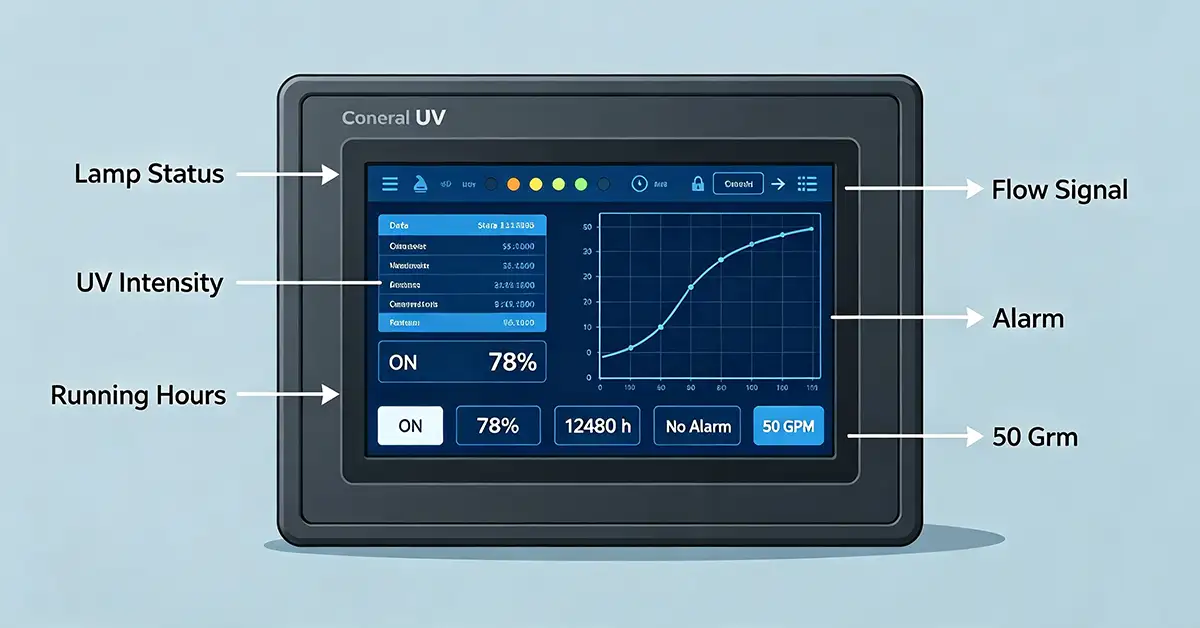
The useful system features include:
- Lamp status
- Lamp-hour counter
- Audible alarm
- Visual alarm
- UV intensity sensor
- Low-UV warning
- Flow monitoring
- Remote alarm output
- Optional automatic shutoff
Even though the lamp can glow, its UV output may have been changed.
That is why the UV intensity sensor provides more valuable information than a simple power indicator.
Commercial Aquafine systems, for example, offer controller functions like lamp replacement countdown and optional UV-intensity monitoring with low-UVI alarm functions.
How Often Does a Commercial UV System Need Maintenance?
The maintenance period depends on the system.
The main tasks include:
- UV lamps check
- Quartz sleeves check
- O-rings and seals check
- UV sensor check
- Controller check
- Filters check
- Chamber condition check
- Alarm check
The quartz sleeves may be covered with mineral or other deposits.
As a result, less UV can be applied to the water.
The sleeve may need cleaning or replacement.
The lamp output changes with the lamp operating time.
Follow the manufacturer’s recommendations on service period rather than waiting until the lamp stops producing visible light.
Some commercial systems have automatic lamp-life reminders helping operators with planning the service period.
Where Are Commercial UV Water Treatment Systems Used?
Hotels and Resorts
UV can be applied as the part of the drinking water or process water treatment chain.
The high peak flow should be taken into account while sizing.
Restaurants
Restaurants can use commercial UV for their private well water or as the part of the full water treatment system.
The water quality influences the food, drinks, ice and cleaning.
Food and Beverage Plants
UV can be used for microbial control without addition of any disinfecting chemical during the UV step.
The applications include the water for ingredients or process-water loops.
Breweries
Water treatment can provide the protection of the product consistency.
The treatment chain should be designed considering the source water and brewing process.
Farms
UV systems can be applied for the water treatment for livestock, crops, washing process or farm buildings.
Schools and Commercial Buildings
The properly designed point-of-entry system can treat the water before it is supplied to the building distribution system.
Laboratories and Pharmaceutical Facilities
UV is also used in high-purity process-water and recirculation applications.
Aquafine includes laboratory, medical, pharmaceutical make-up water and final electronics rinsing among the applications for its industrial UV systems.
How Much Does a Commercial UV Water Treatment System Cost?
There is no universal price.
The cost depends on:
- Flow rate
- UVT
- UV dose
- Lamp technology
- Lamp quantity
- Reactor size
- Monitoring
- Certification
- Pretreatment
- Installation
- Replacement lamps
- Energy use
- Maintenance cost
The small commercial system will be very different from the system for hundreds of gallons per minute.
While comparing the quotes, compare the whole system not only the reactor price.
Ask for:
- Equipment price
- Installation cost
- Annual lamp cost
- Sleeve cost
- Filter cost
- Energy use
- Sensor service
- Expected maintenance time
This information will give you the full picture of the cost of ownership.
Commercial UV Water Treatment Systems Buying Checklist
Before ordering the system, gather this information:
- Peak flow rate
- Minimum and maximum flow
- UVT
- Water source
- Water test report
- Treatment goal
- Required UV dose
- Pipe size
- Operating pressure
- Water temperature
- Available voltage
- Installation space
- Required certification
- Alarm requirements
- Remote monitoring needs
- Replacement lamp cost
- Service access
The supplier asking only “How many GPM?” may not have enough information to size the critical commercial UV project.