
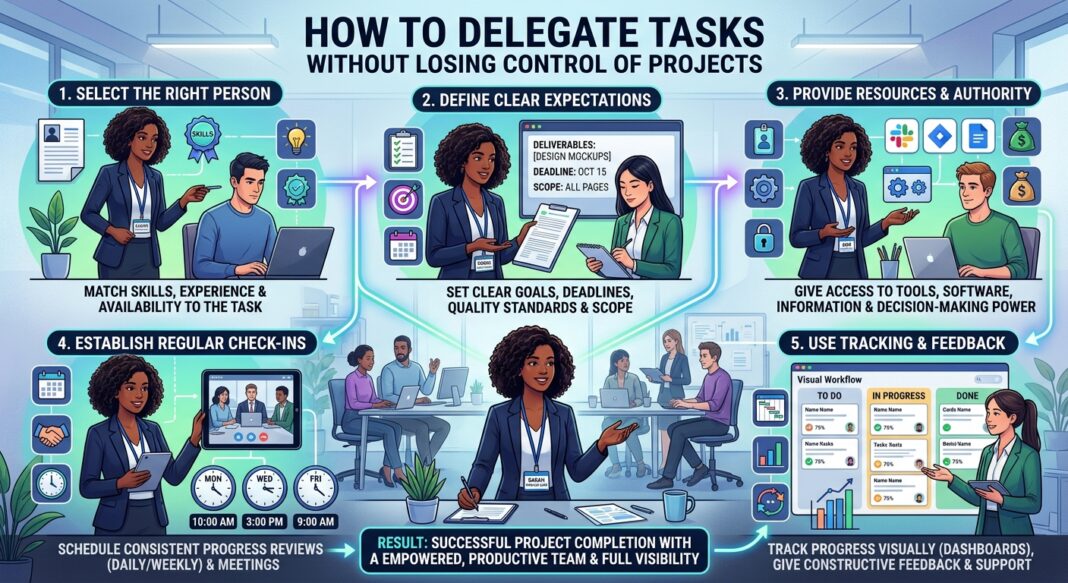


Until recently, managers often believed that the best way to ensure a job was done well was to do it themselves. But today, things are different.
An effective leader doesn’t have to be involved in every detail or hover over a person doing the work, checking their every move. Modern managers trust their teams.
By delegating properly, you avoid the bottleneck where ten people wait for one to decide. It takes the load off the person who has to do the management stuff and allows the team to grow.
After all, delegation makes a project more successful. Work doesn’t stop when a key team member gets sick or goes on a business trip.
Many teams work remotely today. They communicate via messaging apps and chats. The progress of their tasks is visible in project management tools, so there is no need to constantly check on how things are going. The nature of oversight has changed: direct intervention has given way to process transparency.
Most importantly, delegation and control are not opposites. You only lose control if tasks are handed off poorly and you don’t get the result you want. The rest is all about the right technique.
How do you assign work without losing control of projects?
In this article, we give you practical tips to do it.
8 tips for those who want to learn how to delegate tasks without losing control of a project
Below, you will find steps and techniques that work for teams of any size, from two freelancers to a 70-person business.
Some of them relate to tools, while others focus on phrasing and agreements.
1. Visualize projects using online planning software
Every manager needs to understand the importance of promptly transferring all plans for a future project from their head into a single, manageable workspace.
Luckily, there are many powerful online tools for this available today. They show who is doing what, when they are doing it, and what they need to do before they can start another task.
One of the most useful solutions is a Gantt chart. It provides a friendly timeline with each task represented as a bar showing the start date, end date, and the person responsible.
Modern Gantt chart scheduling software allows you to lay out logical dependencies between tasks. If the design phase slips by three days, you can instantly see the layout and content release phases move along.
You get a clear, real-time overview of the whole project before you even start delegating tasks.
2. Identify tasks that will not be delegated
Before handing off a piece of work to someone else, clearly define the activities and areas of responsibility that you believe should not be delegated.
Compile a list of the important decisions and issues that only you can make. They may include project finances, final strategy, hiring, or client agreements. Then everything else can be delegated to others.
Having such a list ensures you will know in advance that key project stages will not be overlooked.
It’s essential to review this list every couple of months. As a team grows, the list should get shorter, not longer.
3. Prepare the context before handing off a task
If someone you are delegating to receives it without context, they will essentially be working in the dark.
The goal of the task should be clearly stated, what kind of output to expect, and who will evaluate the output.
If you give context, a person doing the work can answer small questions on their own.
A few minutes spent explaining the details upfront can save you from a dozen follow-up messages.
Conversely, the less context you provide, the more often you will be asked questions about every little thing.
4. Delegate authority together with responsibility
Often delegation leads to the situation where a person is responsible for the result but doesn’t have the power to make decisions. In fact, responsibility without authority is a snare.
When delegating a task, give all the information needed to complete it, including budget, contacts, access rights, authority to talk directly with contractors, etc.
If every step in a task being performed by a worker has to be approved by a manager, it just adds another layer of bureaucracy and headaches that are unnecessary.
You can start by giving away small amounts of authority and then gradually increase the scope.
5. Use the “One task, one owner” rule
The real reason projects stall quietly is that accountability is murky.
When two people are responsible for a task, it is often only half done.
You can assign tasks to anyone, but there must be a single owner for the outcome. This is the person you will speak to regarding the status.
This is especially important in teams where well-meaning colleagues like to get involved in others’ tasks.
Every project plan must list the name of the person responsible, not just a department name or a generic label like “marketers.”
If three people are actually working on a task, break it down into three separate tasks, each with its own owner and deadline.
6. Agree on a monitoring process in advance
Unannounced inspections are uncomfortable for everyone on a team.
To prevent negativity, set specific times to review interim results when you assign the task. Describe how you will review the structure, the first draft, and the final version.
Link these reviews to project milestones, not to specific days of the week. You should only assess work if there is work to be assessed.
Do not interfere with the process between scheduled progress checks. A person performing certain work knows when a report will be required, which allows them to work without undue pressure.
This also minimizes your anxiety, as you don’t have to wonder if the task is progressing — the review date is already on the schedule.
7. Focus on verifying understanding at the input stage rather than just the final output
A manager must make sure that a person doing a specific task understands the full scope and essence of it.
It’s just a case of getting them to rephrase the task in their own words. Let them tell you what to do and when to do it.
Identify potential risks immediately. Take into account obstacles, missing information, or unresolved questions.
8. Analyze results and create templates from them
Delegation works best when you don’t have to keep repeating the same things over and over again.
What worked, what didn’t, and what was missing when the task handover process started.
Turn your insights into checklists, task templates, or short instructions.
After a few projects, you’ll have a knowledge base that allows a new person to get up to speed with minimal hand-holding from you. Feedback should be on the process and the outcome, not the person’s character.
That’s all for now. However, the useful tips certainly don’t end with this collection. You can surely add to this list.
Make delegation your strength, not just a formality
Ineffective delegation isn’t always about the people involved.
It can fail due to how the work is structured or the attitude toward the process itself — specifically, when the desired outcome isn’t defined, progress isn’t visible, and the boundaries for decision-making haven’t been established.
When all three of these elements are in place, trust is no longer a risk, and delegation is smooth and effective.
Implement the suggestions given above and stop trying to do it all yourself.