
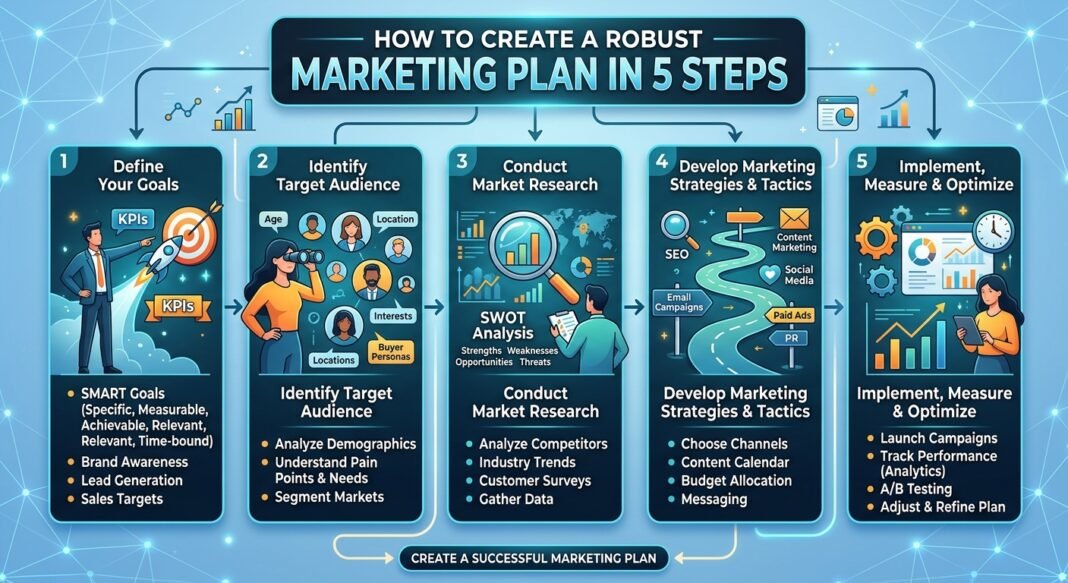


A good plan is the starting point of any project. It’s a mantra that juniors and the most seasoned marketing professionals should repeat.
Of course, you can just advertise without any preparation, or send out emails to clients with text created in a minute. But such an approach is unlikely to yield effective results.
All marketing initiatives should start with the planning process, whether it’s developing a content strategy, rebranding a cafe, launching a creative campaign, producing a video, or running a promotion for an online store.
Nevertheless, there are marketers today who still view planning as nothing more than a tedious formality. To them, a project plan is just a dull document that can be put off until later.
In this article, you will find 5 concrete steps that will help you create an effective marketing plan that will become a powerful business lever.
5 proven steps to crafting a great marketing plan
If your marketing plan clearly outlines what you want to achieve, who your target audience is, what the costs will be, and what the expected outcomes are, then it can be considered effective.
The length doesn’t matter: it can be just a few pages, a simple table, or a detailed visual timeline.
The key is to view a plan not as a formal report for top management, but as a practical tool for making significant business decisions.
Let’s dive into the steps for creating such a plan. They are presented in a logical sequence, as each step builds upon the one before it.
1. Choose the right tool for planning marketing tasks
While the scope and content of your plan are certainly important, you should also consider where it will be stored and how it will be visualized.
It’s easy for a team to get confused by different versions or lose track of critical information if tasks are scattered across chat threads, notes, emails, or various spreadsheets.
Explore available software solutions, test their interfaces and functionality, and evaluate their costs and integration options.
For instance, you can explore the right marketing planning software here.
Focus not on the length of a feature list, but on solutions that will truly work for your specific business needs.
A solo marketer may choose a simple app with a to-do list and a calendar sufficient. A marketing department, however, comprising advertisers, copywriters, designers, video creators, and others, will benefit from a multifunctional Gantt chart with task dependencies and deadlines.
Before migrating all your work into a new program, try setting up one actual campaign within it. If, after a couple of days, your team starts opening it without needing any reminders, then you’ve made a good choice.
2. Know your audience better
Two male customers of the same age may purchase your product for entirely different reasons. Therefore, a statement like “our target audience is men aged 30–40” reveals very little about the actual individuals.
Try to dig deeper and examine the specific problems consumers are trying to solve, as well as the obstacles currently preventing them from doing so. Identify where they go to find information. Look into the doubts that often arise for them before making a purchase.
Сonduct a survey, set up a focus group, and check available reviews. Create several typical customer personas using this data.
Share these insights with your copywriters, designers, and a sales team. After all, everyone should be thinking about the same person.
3. Select key messages and approve channels
Now that you have selected your planning software and have information about your target audience, it is time to define your key messages and determine how you will deliver them.
Keep them brief. Each message should make it crystal clear what value you give your customers and why they should pick you.
Vague promises will fail to impress. They can even prove counterproductive.
A thorough understanding of your audience should make it easier to select the right communication channels. Don’t focus exclusively on just one; use a variety of options.
Change your messages to fit different formats, but keep the same underlying meaning. This will make sure that your audience identifies you on all platforms – your website, social media, or email newsletters.
4. Manage finances wisely
The ability to allocate a budget effectively is a hallmark of a professional marketer. You must understand what resources to assign to a project and how to use them to transform a dry document into a truly actionable plan.
Find out how to distribute your money effectively across various tasks and channels. Plan your budget from the beginning of a project to avoid surprises later on. Include the cost of subscribing to essential services, producing content, paying contractors and freelancers, and so on.
Think about how much it costs to get one customer, and whether that customer will be profitable.
Focus your spending on the areas you know work. At the same time, allocate a small portion of the budget for experimentation.
Keep a reserve fund to cover any unexpected expenses if they should arise.
5. Focus on evaluating results and the ability to make adjustments
The initial phase of executing a marketing project plan is a time when you may encounter numerous obstacles. They can occur due to market shifts or other external factors.
Before you implement your plan, determine the metrics you’ll measure along the way.
Focus on metrics such as sales volume, number of potential customers (leads), cost of customer acquisition, repeat purchases, and the like.
Ensure that your analytics are functioning correctly. Define in advance the criteria for either halting an activity or increasing its budget.
Don’t forget to schedule regular alignment meetings where you can make adjustments to a plan. Timely updates will ensure that your approach always reflects the current situation.
Certainly, there may be other useful steps. You have covered the most important ones here, but nothing prevents you from expanding this list and continuing to work with it.
Turn your goals and initiatives into a powerful marketing plan that will help you outperform competitors
Even the most effective plan can quickly run into challenges. A new trend may emerge in the market tomorrow. Your primary marketing channel can become more expensive. Competitors may lower their prices.
However, this shouldn’t lead you to believe that the planning process was a waste of time.
When you put in the time and effort to plan, you know exactly who your audience is, what to focus on, and where exactly you can find opportunities for success and growth. And if things don’t work out, you can pivot quickly instead of starting over.
A good marketing plan defines exactly what you will not do. This empowers you to say “no” to random ideas, trendy channels, or urgent, ill-founded requests, ultimately helping you save your budget.