


Every seasoned traveller has that one destination they return to again and again. For a growing number of Europeans — and visitors from further afield — that place is Rovinj, a small coastal town on the western tip of the Istrian peninsula in Croatia. It has all the ingredients: cobblestone streets, turquoise water, centuries of history, incredible food, and the kind of light that makes every photograph look effortless.
But there’s a secret that Rovinj regulars know and rarely share: how you stay here matters as much as where you go.
Rovinj: More Than a Pretty Postcard
Rovinj has been drawing visitors for over two thousand years — and for good reason. The city wraps around a small peninsula, crowned by the Baroque church of St. Euphemia whose bell tower watches over the Adriatic from 60 metres up. Below it, a labyrinth of narrow alleyways, artist studios, and terrace restaurants tumble down toward the waterfront.
What makes Rovinj special compared to Croatia’s more heavily touristed spots is its balance. It’s genuinely beautiful without being overrun. The old town is car-free and unhurried. The surrounding coastline includes the Zlatni rt (Golden Cape) forest park — a protected nature reserve of ancient oak and pine where you can cycle, swim off the rocks, or simply sit with a book while the sea breeze does its work.
And the food. Istria has quietly become one of Europe’s most celebrated gastronomic regions, with its black and white truffles, olive oils, pršut (dry-cured ham), and wines that hold their own against Italian and French competition. You can eat extraordinarily well here — from waterfront konoba restaurants to Michelin-recognized fine dining — without the prices you’d expect.
The Accommodation Question: Why More Travellers Are Choosing Nature Stays
For years, “camping in Croatia” conjured images of overcrowded plots on dusty ground, shared facilities, and noise until midnight. That era is largely over.
A new generation of nature-focused accommodations has raised the bar significantly, offering genuine immersion in the landscape alongside comfort that doesn’t ask you to compromise. This shift has been particularly pronounced in Istria, where the combination of mature pine forests, mild Mediterranean climate, and a short drive to the coast makes the region ideal for it.
The philosophy is straightforward: you don’t have to choose between being in nature and being comfortable. You can have both.
Porton Nature Hideouts: A Case Study in Getting It Right
Just minutes from Rovinj’s old town, Porton Nature Hideouts sits on one of the most enviable pieces of land on the Adriatic coast. The name says it all — porton means gate or door in the local dialect, and stepping into this property genuinely feels like crossing a threshold into a different kind of holiday.
The camp is framed by tall, old pine trees and Mediterranean shrubs, which keep temperatures cooler than the surrounding area and create a natural privacy between accommodation units. The view across to Rovinj’s old town is, frankly, extraordinary.
What’s Available
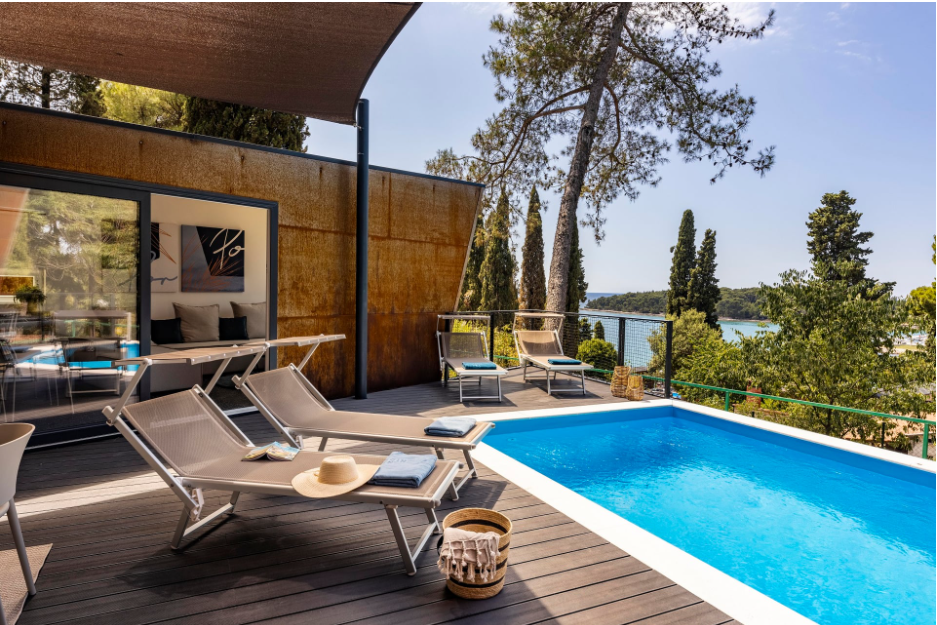
Holiday homes are the flagship offering: modern, architect-designed structures with private pools, well-equipped kitchens, and outdoor terraces that make it easy to spend an entire day without leaving your plot. These work particularly well for couples looking for privacy or families who want their own space without sacrificing proximity to the sea and town.
Mobile homes offer a more classic glamping experience — well-furnished interiors, proper beds, air conditioning — located just a short walk from the Adriatic. The sea here is clean, clear, and famously calm in summer.
Camping pitches are for those who want the full outdoor experience under the pines, without giving up practical amenities. The on-site bakery, 24-hour reception, and shop mean you’re never far from what you need.
What unites all three categories is a genuine commitment to the natural environment. The property doesn’t try to manufacture an artificial resort feel — it lets the landscape do the work, and the landscape here is exceptional.
Practical Notes for Planning Your Stay
Getting there: Rovinj is served by Pula airport (about 35 km south), which handles flights from across Europe, especially in summer. You can also reach the area by ferry from Venice — a scenic option that turns the journey into part of the experience.
Best time to visit: June and September are the sweet spots — warm enough to swim, uncrowded enough to actually enjoy the old town. July and August are peak season, busy and hot, though the pine shade at Porton makes the heat considerably more bearable than in town.
Day trips: Porton’s location makes it easy to explore beyond Rovinj. The medieval hill town of Motovun, the truffle forests near Buzet, the Roman amphitheatre in Pula, and the coastal towns of Poreč and Vrsar are all within an hour’s drive.
Pets: Porton welcomes them — always worth noting for those who travel with animals.
The Bigger Picture
There’s a reason “slow travel” has become more than a buzzword. Staying somewhere with genuine character — a property embedded in its landscape, with history and local identity — produces a fundamentally different kind of holiday than the anonymous hotel room, however well-appointed.
Rovinj rewards that approach. It’s a town built for wandering, for lingering over coffee, for finding the fish restaurant that doesn’t appear on any listicle. And Porton Nature Hideouts provides an ideal base from which to do exactly that — close enough to town to walk in for dinner, far enough to feel like you’ve genuinely escaped.
If you’ve been considering Croatia for your next trip and haven’t looked closely at Istria, now is the time. And if you’ve already ruled out camping as an option, it might be worth reconsidering what camping actually means in 2025.