
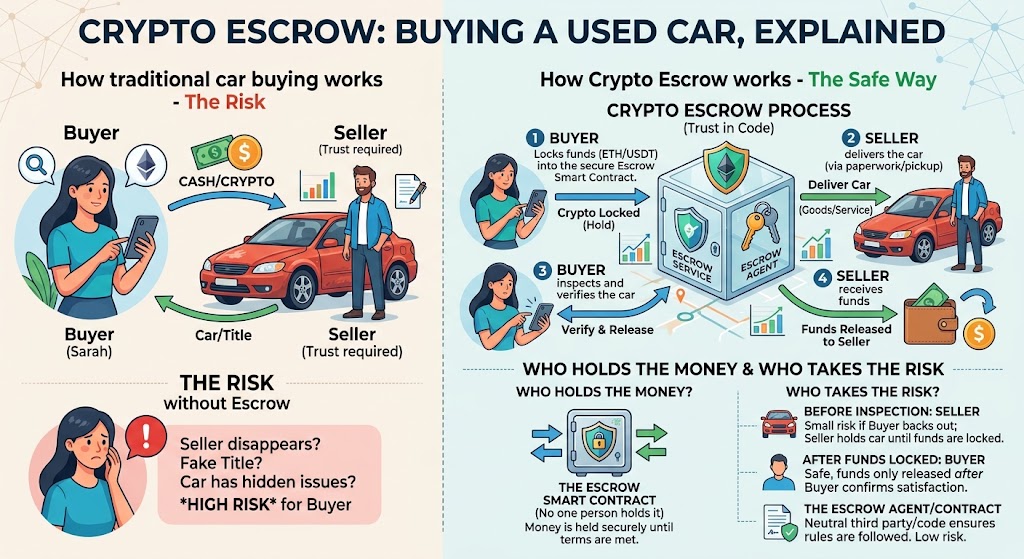


You find a used car online for $8,000. The seller will not hand over the keys until the money clears, and you will not send $8,000 to someone you met an hour ago.
Both of you are being sensible, and the deal is stuck. That standoff is the problem escrow exists to solve, in cars and in crypto.
The two risks in any deal between strangers
In a peer-to-peer crypto trade, the roles match the car sale. The seller has the asset, the buyer has the money, and each worries the other will take what they have and disappear.
Escrow parks the asset somewhere neither side can grab it while the payment happens. The real question is who, or what, is doing the parking.
Option one: the trusted middleman
In the car world, this is an escrow company or a dealer. You pay them, they tell the seller the money is there, the seller signs over the title, and the middleman passes the money along.
Custodial crypto platforms work the same way. When you deposit coins, they move into the platform’s own wallets, and the platform updates its internal records as trades happen.
This is convenient, and often fast. The weak spot is the middleman itself.
If the company fails, freezes withdrawals or shuts down, your money is stuck with it. Customers of FTX, Celsius and Voyager Digital learned this in 2022, and Paxful users had one month to withdraw their balances before it closed in November 2025.
Option two: a lockbox nobody can open early
Now imagine the car keys go into a lockbox at the curb. It opens only when the seller confirms the money arrived, and if the two of you disagree, a referee looks at the evidence and decides.
That is roughly how smart-contract escrow works. A smart contract is a program on a blockchain that follows fixed rules.
During a trade, the seller’s coins sit in the contract instead of in a company’s wallet, and outside of a trade, funds stay in each user’s own wallet. Non-custodial P2P marketplaces such as Senpero use this model, while bitcoin-only tools such as Bisq and Hodl Hodl take their own decentralized
approaches.
What escrow costs
A car escrow company charges a service fee. Crypto escrow has two kinds of cost, and it pays to know both before you start.
The first is the platform’s commission. The second is the blockchain network fee for opening the escrow and again for closing it, since both are on-chain transactions.
Network fees depend on which chain you use and how busy it is, so the same trade can cost more on a congested day. Running your numbers through an escrow fee calculator before a trade shows what the lockbox will cost, and a published
fee table that separates commission from network costs makes comparisons easier.
On small trades, fixed network costs take a bigger bite out of the total. That alone can change which network you choose.
A trade, step by step
- Find an offer. Sellers set their own rate, limits and accepted payment methods, just as a car listing sets the price and terms.
- Open the trade. The seller’s crypto moves into the escrow contract.
- Pay. The buyer sends money by the agreed method, such as a bank transfer, and marks the payment as sent.
- Check. The seller logs into their own bank or payment app and confirms the money has actually arrived.
- Release. The seller releases the escrow, and the coins go to the buyer’s wallet.
- Dispute, if needed. If the buyer says they paid and the seller says they did not, the platform’s dispute process takes over.
Dispute basics
A dispute is the referee stepping onto the field. Typically, both sides submit evidence such as bank statements or transaction records, and the platform decides where the escrowed coins should go.
The best way to win a dispute is to never need one. Keep all communication on the platform, save your payment records, and ignore promises made in private messages.
When escrow cannot help
A lockbox only works if you use it, and only if the person holding the release button checks the facts. Escrow offers little protection in these situations:
- Off-platform deals. If a buyer talks you into trading by direct message to “save on fees,” there is no escrow and no referee.
- Fake payment proofs. If a seller releases coins because of a screenshot, the contract simply does what it is told. GCash, the Philippine e-wallet, has warned that scammers use AI apps to fake receipts, and advises checking the in-app transaction history instead.
- Reversible payments. Crypto transfers are final, but many bank and card payments can be disputed or recalled. A buyer who reverses a payment after the coins are released leaves the seller with a problem escrow cannot undo.
- Third-party payers. Money that arrives from someone other than the buyer can be a sign of a triangulation scam, where the scammer uses a different victim’s funds to pay you. Do not release.
Used-car rules that also work for crypto
- Check the money in your own account, never on the other person’s screen.
- Match the payer’s name to the buyer’s name.
- Keep the whole deal, including chat, on the platform.
- Know the full cost, including network fees, before you open a trade.
- Do not let anyone rush you into releasing.
- If something feels off, stop and open a dispute instead of releasing.
Nobody sensible buys a used car on a handshake and a photo of a bank transfer. The same caution, paired with a lockbox neither side can raid, is what makes trading crypto with a stranger workable.