


Machine learning often gets associated with prediction: forecasting sales, detecting fraud, or classifying customer support tickets. Most of these systems rely on labeled data. Someone has already defined what counts as fraud, which customers churned, or which emails belong in spam folders.
But many real business problems don’t come with neatly labeled datasets. Companies collect enormous volumes of raw information every day — transactions, sensor readings, browsing behavior, support logs, operational metrics — yet much of it has no predefined categories. This is where unsupervised machine learning becomes useful.
Instead of learning from labeled examples, unsupervised models search for hidden structure inside the data itself. They identify patterns, detect anomalies, group similar records, and uncover relationships that may not be visible to analysts manually reviewing spreadsheets.
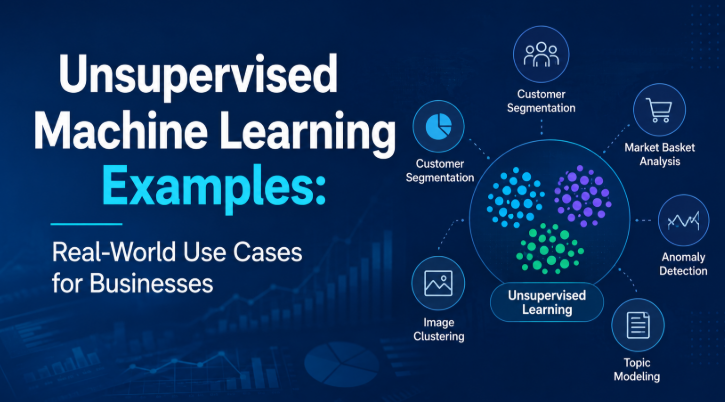
Businesses increasingly use unsupervised learning to improve decision-making, personalize customer experiences, reduce operational risks, and discover opportunities hidden inside complex datasets. Some of the most practical applications appear in customer analytics, cybersecurity, manufacturing, finance, logistics, and healthcare.
What Makes Unsupervised Learning Different?
The biggest difference between supervised and unsupervised learning is the absence of labels. In supervised learning, the model already knows the correct outcome during training. In unsupervised learning, the algorithm receives raw data without predefined answers and must identify meaningful structure independently.
That distinction matters because labeling large datasets is expensive and time-consuming. Many companies simply cannot annotate millions of customer interactions or operational records manually.
Unsupervised models solve this problem by working directly with existing business data. They are especially valuable when organizations want to:
- Understand customer behavior
- Detect unusual activity
- Reduce noise in large datasets
- Discover operational inefficiencies
- Improve recommendations
- Explore unknown patterns before building predictive systems
Modern businesses increasingly combine supervised and unsupervised approaches inside broader AI systems, particularly in large-scale analytics and automation projects. Companies investing in advanced AI infrastructure often rely on practical implementations built around real operational data rather than purely theoretical models. Many businesses exploring these kinds of examples eventually use unsupervised learning as an early-stage discovery layer before deploying predictive AI systems.
Customer Segmentation in Retail and E-Commerce
Customer segmentation is probably the most common real-world example of unsupervised machine learning.
Retailers collect massive amounts of behavioral data: purchase history, browsing patterns, product preferences, average order value, discount usage, and return frequency. However, businesses rarely know in advance how customers naturally group together.
Clustering algorithms such as K-Means help uncover these segments automatically.
For example, an online retailer may discover several distinct customer groups:
- High-spending loyal customers
- Seasonal bargain hunters
- Frequent low-value shoppers
- Customers with high cart abandonment
- Users who mainly purchase premium products
These insights directly influence marketing strategy. Instead of sending identical campaigns to everyone, businesses can personalize promotions, recommend products more accurately, and optimize retention campaigns for each segment.
Streaming platforms like Netflix and Spotify also use clustering techniques to group both users and content, improving recommendation quality and user engagement.
Fraud Detection and Anomaly Detection in Finance
One of the strongest applications of unsupervised learning is anomaly detection.
Fraudulent activity is difficult because fraud constantly changes. Criminal behavior rarely follows identical patterns long enough for fully supervised systems to remain effective on their own.
Unsupervised models help by learning what “normal” behavior looks like. Once the model understands standard transaction patterns, it can flag unusual activity automatically.
Examples include:
- Unusual spending locations
- Rapid transaction bursts
- Abnormal purchasing behavior
- Suspicious account access patterns
- Large deviations from historical activity
Banks and fintech companies often combine anomaly detection systems with supervised fraud models to improve accuracy and reduce false positives.
The same approach works in cybersecurity. Network monitoring systems analyze millions of events daily and identify abnormal traffic patterns that may indicate intrusions or data breaches.
This is particularly useful because many cyberattacks involve previously unseen behavior that labeled datasets may not fully capture.
Predictive Maintenance in Manufacturing
Manufacturing companies generate huge volumes of sensor data from industrial equipment. Machines continuously produce temperature readings, vibration data, pressure measurements, and operational metrics.
Most of this data does not come with labels explaining whether a machine is “healthy” or “about to fail.”
Unsupervised learning helps manufacturers monitor equipment conditions without requiring manually labeled failure datasets. Algorithms learn the normal operational behavior of machinery and identify deviations that may signal upcoming problems.
For example, a production line motor may suddenly begin showing vibration patterns slightly different from historical norms. Even before a breakdown occurs, the anomaly detection system can alert maintenance teams.
This allows businesses to:
- Reduce downtime
- Prevent expensive failures
- Optimize maintenance schedules
- Extend equipment lifespan
- Improve production reliability
Predictive maintenance has become especially important in industries where downtime creates major operational losses, including logistics, energy, automotive manufacturing, and aviation.
Product Recommendation Systems
Recommendation engines are another major example of unsupervised learning in practice.
Most businesses think recommendation systems are purely predictive, but unsupervised techniques often play a foundational role behind the scenes.
E-commerce platforms use clustering and similarity detection to identify relationships between users, products, and browsing patterns. The system may determine that customers who purchase one product category frequently interact with another related category, even if no explicit connection was previously defined.
For example:
- Users buying fitness equipment may also purchase nutritional supplements
- Customers browsing gaming accessories may later purchase streaming equipment
- Enterprise software buyers may show overlapping behavior across related SaaS tools
Recommendation systems built on behavioral similarity improve personalization while helping businesses increase average order value and user engagement.
Large content platforms, including video streaming and media companies, rely heavily on unsupervised clustering to organize content libraries and audience behavior.
Healthcare and Medical Research
Healthcare organizations increasingly use unsupervised learning to identify patterns inside complex medical datasets.
Patient records contain large amounts of information that are difficult to categorize manually. Symptoms, genetic markers, imaging results, medical histories, and treatment responses often contain hidden relationships.
Clustering algorithms help researchers identify patient subgroups with similar characteristics, which may improve diagnosis accuracy or treatment planning.
Examples include:
- Identifying disease subtypes
- Detecting abnormal imaging patterns
- Grouping patients by treatment response
- Discovering early warning indicators
- Supporting personalized medicine strategies
Medical imaging systems also use unsupervised techniques for segmentation and anomaly identification in radiology and pathology workflows.
Although healthcare applications require strong regulatory oversight and human validation, unsupervised learning helps medical organizations process data volumes that would otherwise be impossible to analyze manually.
Dimensionality Reduction for Large Business Datasets
Some datasets become too large and complex for analysts to interpret effectively. Businesses may collect hundreds of variables across operations, customer behavior, or financial reporting.
Many of these variables overlap or contain redundant information.
Dimensionality reduction methods such as Principal Component Analysis (PCA) help simplify large datasets while preserving the most important patterns.
This is especially useful in:
- Financial analytics
- Customer behavior modeling
- Operational reporting
- Industrial IoT systems
- Computer vision pipelines
For example, instead of analyzing 150 overlapping operational metrics, PCA may reduce the dataset to a much smaller number of meaningful components that capture most of the variation.
This simplifies visualization, improves downstream model performance, and reduces computational complexity.
Supply Chain and Logistics Optimization
Supply chain operations involve highly dynamic environments with changing demand patterns, transportation delays, inventory fluctuations, and regional differences.
Unsupervised learning helps businesses identify operational inefficiencies and unusual patterns across logistics networks.
Examples include:
- Detecting abnormal delivery delays
- Grouping suppliers by reliability patterns
- Identifying warehouse inefficiencies
- Segmenting transportation routes
- Finding hidden relationships between seasonal demand trends
Large logistics organizations increasingly rely on machine learning systems to process operational data in near real time, particularly as global supply chains become more volatile.
Instead of manually reviewing dashboards and spreadsheets, businesses can automatically surface patterns requiring attention.
Why Businesses Are Investing More in Unsupervised Learning
One reason unsupervised learning continues growing is simple: unlabeled data is everywhere.
Most organizations already collect large amounts of operational information but lack the resources to structure or annotate it manually. Unsupervised models allow businesses to extract value from existing datasets without waiting for expensive labeling projects.
At the same time, modern AI infrastructure has made deploying these systems more practical than before. Companies now use unsupervised learning not only for research but also for production systems involving recommendation engines, operational monitoring, customer analytics, and automation workflows.
Organizations building scalable AI ecosystems increasingly combine clustering, anomaly detection, and dimensionality reduction with broader machine learning strategies. Teams focused on production-ready AI systems often integrate unsupervised learning into forecasting, automation, and decision-support pipelines to improve adaptability and uncover patterns traditional reporting may overlook.
Final Thoughts
Unsupervised machine learning is less about predicting known outcomes and more about discovering what businesses do not yet see inside their data.
That difference makes it incredibly valuable in modern environments where information grows faster than teams can organize it manually.
From fraud detection and predictive maintenance to customer segmentation and recommendation systems, unsupervised learning helps organizations uncover hidden structure inside complex datasets. In many cases, these insights become the foundation for larger AI initiatives later on.
As businesses continue collecting more operational and behavioral data, the ability to identify patterns without relying entirely on labeled datasets will become increasingly important. Companies that successfully integrate unsupervised learning into their analytics workflows gain a stronger understanding of customers, operations, and emerging risks long before those patterns become obvious through traditional analysis.