


A driveway is the first thing anyone sees when they arrive at your house, and it is usually the last thing anyone thinks about cleaning. Left alone, it goes green in winter, grows weeds through the joints in summer, and picks up oil marks all year round.
The good news is that a tired driveway almost always comes back. The question is whether to do it yourself and what it costs if you do not.
Match the method to the surface
Driveways in the UK come in four common types, and they do not all want the same treatment.
Block paving. The most common modern driveway. Durable, tolerates pressure washing well, but the jointing sand comes out during cleaning and must be replaced.
Concrete. Very tolerant. Pressure washes easily, though older concrete can be pitted and holds oil stains stubbornly.
Tarmac and asphalt. This is the one to be careful with. High pressure at close range dislodges the surface aggregate and can leave permanent patches. Tarmac is best cleaned with lower pressure, a wide fan and a suitable cleaning solution rather than brute force.
Gravel and resin bound. Gravel cannot be pressure washed conventionally. Resin bound surfaces can be cleaned but need moderate pressure to avoid damaging the resin.
Pattern imprinted concrete. Sealed, and the seal is the thing you are protecting. Clean gently and expect to reseal afterwards.
The method, step by step
- Clear everything off. Cars, bins, bikes, pots.
- Sweep and weed. Pull weeds from the joints properly, roots included. A weeding knife is worth the few pounds it costs.
- Treat oil stains separately. Water spreads oil. Use a dedicated degreaser or an absorbent poultice, applied and left to draw the oil out, before you wash anything.
- Apply a moss and algae treatment. This is the step that decides whether the driveway stays clean for a season or a month. Blasting green growth off with water leaves the spores behind. A proper treatment kills it. Apply on a dry, still day and leave it for the time the product specifies.
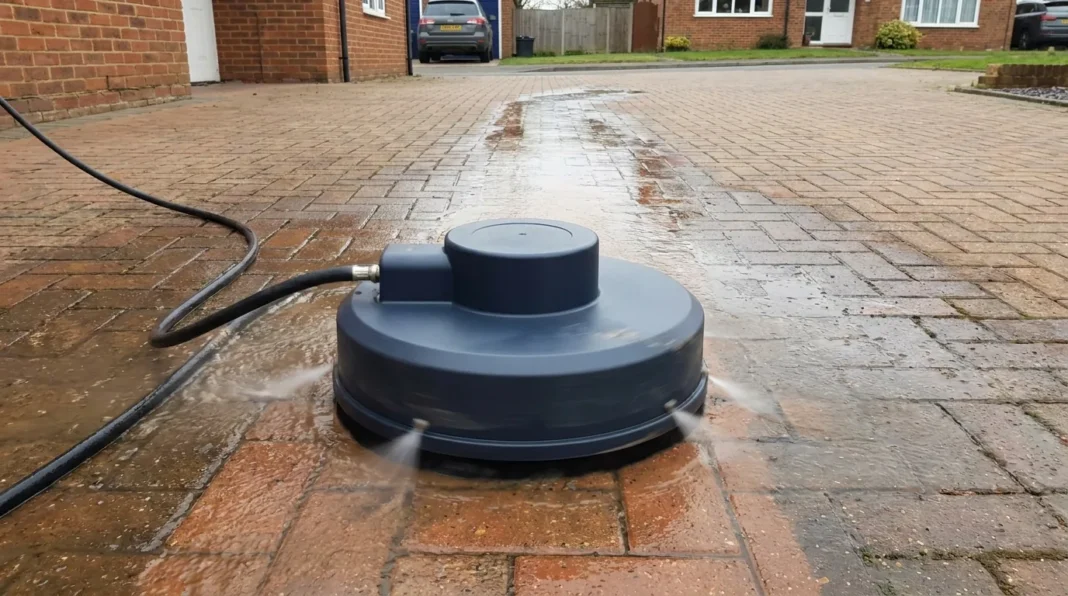
- Wash. Use a fan nozzle rather than a pencil jet, keep the lance a consistent distance from the surface, and keep it moving. A rotary surface cleaner attachment gives a far more even finish than a hand held lance and is the difference between a professional looking result and visible stripes.
- Rinse and clear the drains. Push the dirty water and silt towards a suitable drain rather than letting it settle back.
- Re-sand block paving. Once the surface is completely dry, brush kiln dried sand into every joint with a soft broom. Top it up again a week later once it has settled. Skipping this leads to blocks shifting and spreading.
- Consider sealing. Optional, but on block paving and imprinted concrete it reduces staining, slows weed growth and makes the next clean much easier. The surface must be fully clean and fully dry first.
Hiring versus doing it yourself
Doing it yourself costs the price of a machine and a day of your time. A domestic pressure washer suitable for driveway work sits in the low hundreds of pounds, or you can hire one by the day for considerably less. Add a surface cleaner attachment, a cleaning product and kiln dried sand.
Where it works well: small to medium block paving or concrete driveways in reasonable condition, where you have a weekend and do not mind the work.
Where it falls down: heavy moss and ingrained algae that a domestic machine cannot shift, large areas where hand held lancing takes forever, tarmac and delicate surfaces where the risk of damage is real, oil contamination that needs specialist treatment, and any job where you would rather not spend a Saturday soaked to the knees.
Hiring a professional buys stronger equipment, a rotary cleaner that produces an even finish, the right chemical for the surface, and someone else dealing with the silt, the drains and the re-sanding.
What driveway cleaning typically costs
Prices vary by region, and London tends to sit at the higher end. Most companies price either by the square metre or as a fixed price per job after seeing photos or measurements.
As a rough guide for the UK market:
Cleaning only. Often quoted in the region of a few pounds per square metre, with most companies applying a minimum charge for small jobs. A modest driveway for one or two cars commonly lands somewhere in the low to mid hundreds of pounds.
Cleaning plus re-sanding. Usually a modest addition to the cleaning price, since the sand itself is inexpensive and the labour is fairly quick.
Cleaning, re-sanding and sealing. Typically the largest jump, often adding as much again or more, because sealer is expensive and the job needs dry conditions and a second visit.
Extras that raise the price: heavy moss requiring pre-treatment and a second pass, oil or paint contamination, weeds that have taken hold in the joints, difficult access with no parking for a van, no water supply on site, very large areas, and steep or stepped driveways.
Things that lower it: a surface that has been maintained, easy access, combining the driveway with a patio or path in the same visit, and booking outside the spring rush.
Because the variables genuinely matter, most reputable companies will not give a firm price without seeing the driveway or at least a photograph and a measurement. Anyone quoting a fixed price sight unseen is guessing, and the guess usually gets revised on the day.
Questions worth asking before you book
- Is the quote per square metre or a fixed price for the job?
- Does it include re-sanding block paving?
- Is sealing included or extra, and which sealer do you use?
- What happens to the waste water and silt?
- Are you insured, and for how much?
- Will you pre-treat moss and algae, or just wash?
- How long before I can park on it again?
That last one catches people out. After sealing in particular, the surface needs time before vehicles go back on it.
Getting a realistic quote
If you want an accurate figure, measure the area in square metres, take a couple of photographs including any problem areas, and note the surface type. Most driveway cleaning specialists in London and elsewhere can price fairly closely from that, and companies such as driveway cleaning specialists in London will typically confirm on site before starting.
Keeping it clean afterwards
The cost of the next clean depends almost entirely on what you do in between.
- Sweep leaves promptly in autumn, since rotting leaf matter is what feeds moss
- Apply a moss and algae treatment once or twice a year
- Top up jointing sand annually on block paving
- Deal with oil drips quickly rather than letting them soak in
- Cut back plants that keep areas permanently shaded and damp
- Keep gullies clear so water drains rather than sitting
A driveway that gets a light treatment twice a year rarely needs a full restoration clean. One that gets ignored for five years usually does, and that is the more expensive path.
One planning point worth knowing
If you are replacing rather than cleaning a front driveway in England, there are rules about surface water. Laying an impermeable surface over more than five square metres of a front garden generally requires planning permission unless the water is directed to a permeable area within the property. Permeable paving, gravel and properly drained designs avoid the issue.
Not relevant to a clean, but very relevant if the conclusion of your inspection is that the driveway has had its day.