


Ask any veteran Diablo 2 Resurrected player what keeps them coming back and the answer usually comes back to the same thing: items. Not just any items — the specific ones that define builds, the pieces that feel genuinely rare, the drops that make an entire farming session worthwhile the moment they hit the ground. D2R has been producing those moments for over two decades, and the items at the top of the value hierarchy have remained remarkably consistent throughout.
This is a guide to the most sought-after items in the game, why they hold their value, where to find them, and what realistic options exist for players who want to gear efficiently without committing hundreds of hours to targeted farming.
What Makes a D2R Item Valuable
Value in D2R flows from a combination of scarcity, build impact, and demand. An item that is rare but does nothing useful for any popular build will not command much interest. An item that is powerful but drops frequently will normalize to a low price. The items that sit at the top of the market are the ones that are simultaneously hard to find and genuinely game-changing for the builds that use them.
Perfect or near-perfect rolls add another layer. D2R uses a system where many item stats roll within a range rather than landing on fixed values. A Shako with maximum life and magic find is meaningfully better than one at the low end of those ranges, and the market reflects that difference.
High Runes: The Foundation of the Economy
No discussion of D2R value starts anywhere other than high runes. Runes are consumable items used to create runewords — some of the most powerful items in the game — by inserting them into socketed bases in a specific sequence. The higher the rune tier, the rarer the rune and the more powerful the runeword it enables.
Zod is the rarest rune in the game, used to make an item indestructible. Its scarcity alone gives it near-mythical status, though its practical applications are narrower than runes slightly below it in the hierarchy.
Cham applies freeze immunity to the character wearing the item it socketed into — an effect with real defensive value for specific builds and one that keeps demand consistent.
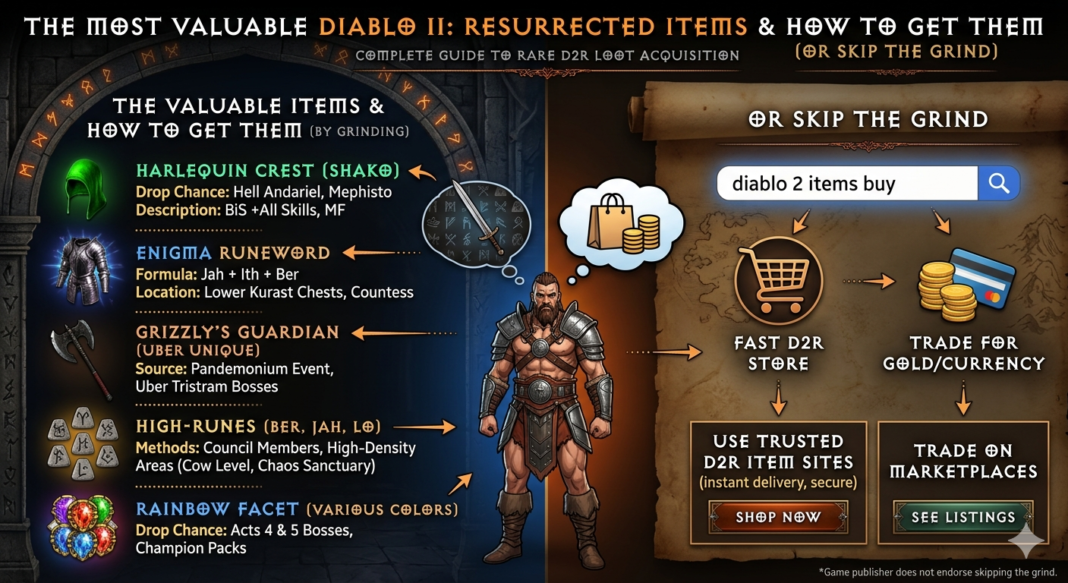
Ber and Jah are arguably the most functionally important high runes in the game because together they create Enigma, the runeword that grants teleport ability to any character class. Enigma has remained one of the most sought-after items in D2R since it was introduced, and the runes required to make it carry corresponding value.
Sur and Lo sit just below that tier and are used in runewords like Dream and Fortitude that define several strong builds.
High runes drop from monsters at low rates that increase with player count in a game. The most efficient farming spots are areas with high monster density and fast reset potential — Travincal in Act Three, the Countess for lower-tier rune farming, and late-game areas in Hell difficulty for the best odds at high runes.
Ladder-Only Runewords
Several of the most powerful runewords in the game are restricted to ladder play — meaning they are only available to characters created during a live ladder season. The items they create cannot be found in non-ladder play, which creates consistent demand at the start of every new season.
Enigma (Jah-Ith-Ber) gives any class access to the Sorceress’s teleport skill, reshaping mobility across the entire game. It is worn by Paladins, Druids, Necromancers, and Amazons who want to move at a pace the game was not originally designed for them to achieve.
Infinity (Ber-Mal-Ber-Ist) is the go-to mercenary weapon for Sorceresses because it applies the Conviction aura, reducing enemy resistance and allowing lightning and cold builds to deal full damage to otherwise resistant enemies.
Grief (Eth-Tir-Lo-Mal-Ral) is widely considered the strongest melee weapon runeword in the game, adding a flat damage bonus that bypasses enemy physical resistance entirely.
Unique Items Worth Farming
Beyond runewords, several unique items sit consistently at the top of the market.
Tyrael’s Might is an armor with an exceptionally low drop rate, dropping only from certain late-game sources in Hell difficulty. Its value is tied as much to scarcity as to stats — though the stats are genuinely strong for specific builds.
Griffon’s Eye is a diadem that adds to lightning skills and applies a lightning resistance penalty to enemies, making it the premier headpiece for lightning-based Sorceresses.
Mara’s Kaleidoscope is an amulet that provides a broad range of bonuses useful to almost any build — skills, resistances, and attributes — making it one of the more universally sought-after amulets in the game.
Shako (Harlequin Crest) is worth mentioning because it sits at an interesting point in the market: powerful enough to wear on almost any character as an upgrade, common enough to be accessible, and widely in demand throughout every season.
Realistic Approaches to Acquiring Top-Tier Gear
Targeted farming is the purest way to acquire D2R’s best items. Running the right areas at the right player count, understanding which sources have the best odds for which items, and sustaining the patience required for genuinely rare drops is the experience the game is built around.
But the reality is that some items — particularly certain high runes and top-tier uniques — have drop rates that make even dedicated farming an exercise in probability over very long timescales. Players who have run Travincal hundreds of times without seeing a Ber rune are not doing anything wrong; they are experiencing variance that is inherent to the system.
For those situations, the broader ecosystem around Diablo 2 items offers a practical route to filling specific gaps. Rather than indefinitely farming for one piece that has not appeared, players can source it directly and return their time to parts of the game they find more engaging. It is a straightforward option that exists alongside organic farming rather than replacing it — useful precisely because it is specific and targeted rather than a substitute for the full experience.
The Items That Define the Experience
What makes D2R’s item system hold up after all this time is that the best items are not just stat improvements — they change what the game feels like. Enigma makes movement feel different. Infinity makes a Sorceress’s damage feel different. Grief makes melee feel like something it was not before.
That is why the hunt for these items remains genuinely motivating across seasons and years of play. The reward is not just a number going up; it is an experience that the item enables. Knowing which items produce that feeling and understanding where they come from is the starting point for making the most of whatever time you put into the game.