
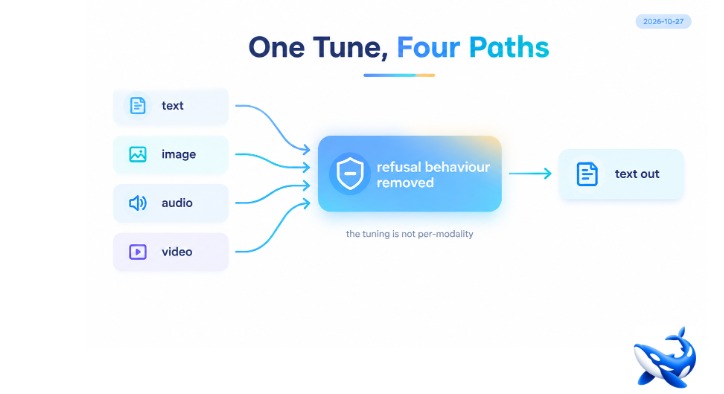


Through OrcaRouter the abliterated MiMo Flash is unusual for a structural reason rather than a benchmark one: it is refusal-free and it accepts text, image, audio and video into the same context [OURS]. Most uncensored builds are text-only, and the ones that are not usually stop at images. Understanding what the tuning did — and did not do — to the other three paths is the difference between a capability you can rely on and one you merely have.
The tuning itself is not per-modality. That single fact explains most of what follows.
One set of weights, four encoders
A multimodal model is one reasoning core with several front ends. Text goes through a tokenizer; images, audio and video go through encoders that project their output into the same embedding space.
Abliteration is a weight-level operation on the reasoning core and its refusal direction. It does not sit in front of one encoder and behind another. So the shape of the tuning is uniform across modalities, even though the evidence you send is not.
Three consequences follow.
Refusal removal applies to everything. A recording that contains a request the base model would decline gets the same treatment as a text prompt asking the same thing.
Capability is not guaranteed to survive equally. The tuning does not damage an encoder directly, but the projection into the reasoning core is what a fine-tune can disturb, and each modality has its own projection.
Behaviour is measurable only per modality. A card can be excellent on text and mediocre on audio without any contradiction.
Why that matters for evidence
Security intake is multimodal precisely because the interesting evidence is not text. The recording where an employee reads out a token, the screen capture where a dialog appears, the dashboard where a series spikes — each is a different encoder path.
If the tuning weakened the audio path relative to the text path, the failure looks like this: the model transcribes the recording imperfectly and reasons confidently about the imperfect transcript. There is no error message, and the output reads well.
The only defence is a probe with material where you know the answer. A two-minute clip in which a specific value is spoken aloud is enough: if the model reports the right value, the path works; if it reports a plausible wrong one, you have found the limit before production did.
What the page claims
The card’s published text describes screenshots, diagrams, dashboards, recorded sessions, captured audio and scanned material being reasoned over alongside source code and long textual context [OURS]. It also reports four benchmark rows, none of which is multimodal [VENDOR].
That is the honest gap: the page sells four modalities and measures none of them. Nothing sinister — multimodal benchmarks are newer and less standardised — but it means the four-input capability is, for now, a claim rather than a measurement.
A three-probe test
Ten minutes per modality, and you will know more than the page does.
Image probe. A screenshot with a specific error code visible. Ask for the code verbatim.
Audio probe. A short clip with a number or a name spoken once. Ask what was said.
Video probe. A screen capture with a transition — a click, then a result. Ask what changed and when.
Score three things per probe: correct, plausible-but-wrong, or refused. The middle category is the dangerous one, and it is the one that only a test with a known answer will reveal.
Where an omnimodal abliterated model is genuinely different
One scenario that no text-only card handles: a request whose evidence spans modalities and whose subject is refusal-sensitive.
A recorded session showing a tool being used against a system you are authorised to test, plus the logs it produced, plus the code that accepted the input. Three modalities, one request, and a general-purpose assistant would decline at least part of it.
That is a narrow scenario and it is exactly the one the card exists for.
Where it is not
Every other case, which is most of them. If your evidence is code and logs, the text-and-image sibling at the same price writes longer reports and scores better on the delivery rows. If your evidence is a single screenshot, an image model suffices.
The card’s advantage is the intersection of two rare properties, and the intersection is smaller than either property alone.
What “removed” means, precisely
Abliteration is often described as if a switch were flipped. The engineering reality is a directional operation in activation space, applied with a strength that trades refusal behaviour against general capability.
Too little and the model still declines. Too much and it becomes incoherent in ways that benchmarks on reasoning will not catch but a long report will.
The four published rows are broad capability measures, and they look healthy. What they cannot tell you is whether the strength chosen for this build sits at the point where refusals stop and coherence holds, or a little past it. That is a judgement the vendor made, and the only way to check it is to read a long output of your own and see whether it stays on the rails.
That is a different test from “did it refuse”, and it is the one people skip.
A practical version: ask for a two-thousand-word analysis of something ordinary in your domain, and read it end to end. Coherence problems in an over-tuned build show up as repetition, contradiction, or a drift into vagueness around the halfway mark — none of which a benchmark catches and all of which a reader notices immediately.
The takeaway
Abliteration is one operation on one set of weights, applied uniformly across four encoders — so the card is refusal-free everywhere and unevenly measured everywhere. The page sells the modalities and benchmarks none of them.
Probe each path with material whose answer you know, and treat “plausible but wrong” as the failure mode to look for. That is the difference between having four modalities and being able to rely on them.
The general lesson for anyone buying an uncensored model: the tuning is a single operation with system-wide effects, and the vendor’s strength setting is a judgement you inherit. Testing one modality tells you about that modality; testing three tells you about the build.
Sourcing note: modalities, capabilities, pricing and the access gate are from the OrcaRouter model page, checked 2026-10-27 [OURS]. The four benchmark rows are OrcaCyber’s own claims, evaluated 2026-09-20, and none is multimodal [VENDOR]. The probes described are suggestions for the reader’s own evaluation, not measurements.