
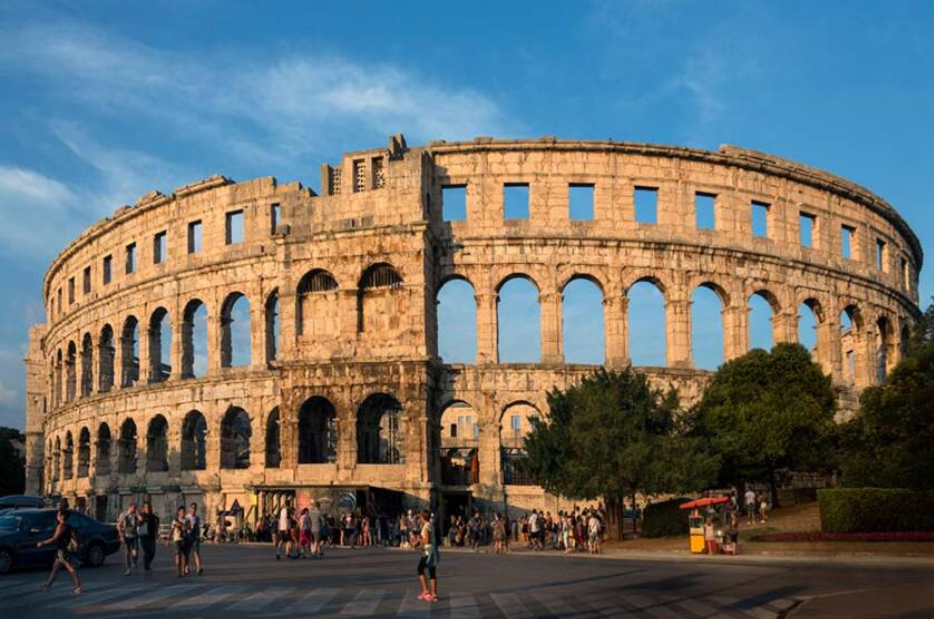


Most visitors come to Pula for one reason: the Arena. And they should. The first-century Roman amphitheatre is one of the best-preserved in the world, and seeing it lit up on a summer evening is hard to forget.
But if you only see the Arena, you miss half the story. For about 60 years before the First World War, this small Istrian port was the main base of the Austro-Hungarian Navy. Engineers, officers, shipbuilders and early aviators came here from across the empire. They left behind forts, tunnels, shipyards and cemeteries, and much of that is still there if you know where to look.
Here’s how to see Pula’s other history.
How a fishing town became an imperial port
In the mid-19th century, Pula was a quiet town inside a deep, sheltered bay. The Habsburg navy needed a safe harbour on the Adriatic, and the bay was ideal. The Uljanik shipyard was founded in 1856, and over the next few decades the town grew quickly. Barracks, officers’ villas, a naval hospital and a Secession-style town centre went up almost overnight.
By the early 1900s, Pula was one of the most technologically advanced places in the empire. Warships were built here, submarines were tested in the bay, and some of the earliest experiments in naval aviation took place a few hundred metres offshore.
Start where the seaplanes flew: Sveta Katarina and Cape Monumenti
Just north of the city centre, a small island called Sveta Katarina (St. Catherine) sits at the mouth of the bay. A bridge links it to Cape Monumenti, a green peninsula with the sea on three sides.
This quiet corner was once among the most important sites of the Austro-Hungarian naval base. It’s often described as the cradle of Croatian military aviation. A seaplane test flight took place here in 1912, only two years after Henri Fabre flew the world’s first seaplane in France. Seaplanes, submarines and some of the largest radio transmitters in Europe were built or run from this small stretch of coastline. Pilots who later became famous in the First World War trained here.
After a century as a closed military zone, the area has opened up. The original naval buildings are under heritage protection. Two of them are now part of Hotel Monumenti, a boutique hotel that calls itself a “hotel-museum.” The room wallpapers reproduce old nautical maps, ship drawings and early seaplanes, made in collaboration with the city’s maritime museum. Even the hotel’s emblem hides a ship, a submarine and a seaplane, all built on this site more than a century ago.
Even if you’re staying elsewhere, the cape is worth a walk. The views run from the Arena across the bay to the Brijuni Islands on the western horizon. At sunset, this is one of the best viewpoints in southern Istria.
Climb to the forts
Austro-Hungarian engineers ringed Pula with fortifications. Many of these stone forts are still standing, some half-hidden by pines and scrub. Fort Munide, a short walk uphill from Cape Monumenti, belongs to this 19th-century system and shows how thoroughly the empire protected its naval base.
Other forts are scattered around the city and the nearby coast. Some have been restored as cultural venues, and others are best explored carefully and in daylight. Taken together, they show how much the Habsburgs valued this harbour.
Tip: Wear proper shoes. Paths to the smaller forts are often rough and unmarked.
Go underground: Zerostrasse
In the heart of the old town, a network of tunnels runs beneath the hill below the Venetian castle. Known as Zerostrasse, the tunnels were dug by the Austro-Hungarian military before and during the First World War as shelters and connecting passages.
Today you can walk through part of the network. It’s cool inside even in August, which makes it a good break from the midday heat. The tunnels come out near the city centre, so they fit easily into a walking tour.
Visit the Historical and Maritime Museum of Istria
At the top of the same hill, the 17th-century Venetian fortress (Kaštel) houses the Historical and Maritime Museum of Istria. Its collections cover Pula’s naval past: ship models, uniforms, maps and photographs from the Austro-Hungarian era. The castle walls also give one of the best panoramic views over the city, the harbour and the shipyard cranes.
Walk the naval cemetery
The Austro-Hungarian Naval Cemetery (Mornaričko groblje) is one of Pula’s most atmospheric and least visited sites. Sailors, officers and their families from all over the empire are buried here under cypress trees, and the headstones are carved in German, Hungarian, Italian, Czech and Croatian. It’s a quiet reminder of how international this port once was.
Look up in the old town
Once you know the story, Pula’s streets read differently. Many buildings around the centre date from the naval boom and share the elegant lines of the Viennese Secession. A plaque and statue near the Arch of the Sergii recall another visitor from that time: James Joyce, who taught English to Austro-Hungarian naval officers here in 1904–05.
Don’t skip the older layers
Pula’s naval story sits on top of much older history. Alongside the Arena, the Temple of Augustus and the Arch of the Sergii are both still standing. Just outside the city, Nesactium (Nezakcij) preserves the remains of the Histri, the pre-Roman people who gave Istria its name. Across the channel, the Brijuni Islands national park has Roman villa ruins and even dinosaur footprints on its shoreline.
A suggested one-day heritage route
- Morning: Walk or cycle to Cape Monumenti and Sveta Katarina, then climb to Fort Munide.
- Late morning: Head into town for the Zerostrasse tunnels.
- Lunch: Eat in the old town, then walk up to the Kaštel and the maritime museum.
- Afternoon: Visit the naval cemetery, then the Temple of Augustus and the Arch of the Sergii.
- Evening: See the Arena at golden hour, or go back to the cape for sunset over Brijuni.
When to go
Late spring and early autumn are the best times to explore Pula on foot. The weather is warm without the peak-summer crowds, the forts and trails are pleasant to walk, and the sea is still warm enough to swim. September and October are especially good.
The takeaway
Pula is often treated as a quick stop for the Arena on the way to Istria’s beaches. But the city has one of the most unusual histories on the Adriatic: an imperial naval capital where seaplanes, submarines and radio transmitters were tested more than a century ago. Give it a couple of days. Much of that history is still standing, and some of it is now open to visitors in ways that weren’t possible a generation ago.