
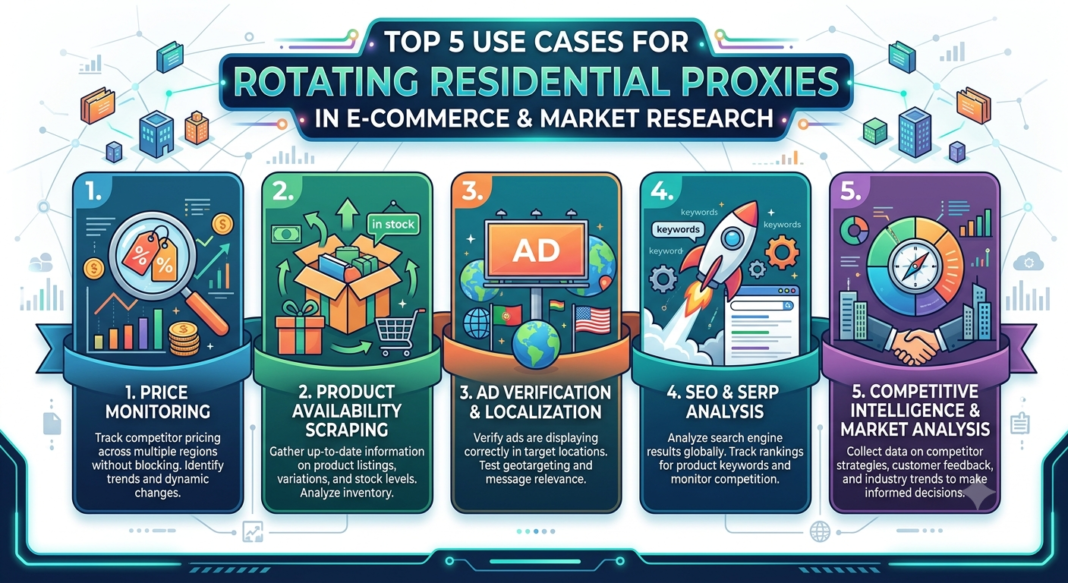


Rotating residential proxies aren’t a single-purpose tool. The same infrastructure that feeds a price monitoring pipeline on Monday handles SERP tracking on Tuesday and ad verification on Wednesday. What ties these use cases together is a shared requirement: the target must see a real consumer making a normal request, not a server running automation.
What follows are the five use cases where rotating residential proxies deliver the most concrete business value — with the specific mechanics of why they work and where they fail without them.
1. Competitor Price Monitoring
Dynamic pricing is now the default for any serious retailer. Amazon reprices millions of SKUs per day. Airline fares change by the hour. Hotel rates shift based on search behavior, device type, and session history. Tracking this accurately is a fundamental competitive intelligence function — and it’s where datacenter proxies fail most visibly.
The problem isn’t just getting blocked. It’s getting wrong data without knowing it.
Major e-commerce platforms serve different responses based on IP reputation. A known datacenter IP might receive a valid-looking product page — correct HTML structure, no error — but with a price that’s been sanitized for bot traffic, a “list price” rather than the current sale price, or a product availability status that doesn’t reflect real inventory. The scraper reports success. The data is wrong.
Rotating residential proxies solve this at the IP layer. Each request arrives from a different consumer ISP address in the target geography, and the platform responds as it would to a real customer. Combined with city-level targeting, this also captures geo-specific pricing — a significant variable on platforms that price by market.
What to watch for: Even with residential IPs, response validation matters. Check that prices fall within expected ranges, that availability flags match across multiple requests for the same SKU, and that the page structure is consistent with what a browser renders. Silent data degradation can happen at the application layer even when the IP passes.
2. SERP Tracking and Rank Verification
Search results are not global. A query for “running shoes” from a residential IP in Chicago returns different results than the same query from Tokyo, Berlin, or São Paulo — different rankings, different featured snippets, different local pack results, sometimes entirely different sets of URLs in the top 10.
Most rank tracking tools in the market solve this badly. They use datacenter IPs with geographic labels, which means they’re measuring what Google shows to a known data center in a claimed location — not what a real user in that city actually sees. Google has been aware of datacenter ASNs for years and has no obligation to show them the same results it shows consumers.
Rotating residential proxies fix this at the source. A request routed through a residential IP in Osaka, on a Japanese ISP, with appropriate language headers, returns the SERP a real user in Osaka sees. Run at scale across cities and devices, this gives accurate local ranking data that datacenter-based tools structurally cannot provide.
Practical implementation: Use per-request rotation with city-level targeting. Each rank check for a keyword/city combination should use a fresh IP — reusing IPs across repeated queries to the same search engine triggers rate limiting that degrades data quality. Keep query cadence realistic: 2–5 second intervals with jitter, not sub-second bursts.
3. Marketplace and Aggregator Data Collection
Price comparison sites, travel aggregators, real estate platforms, and job boards aggregate data from multiple sources and add their own pricing logic on top. For businesses that need to monitor these aggregators — to understand how their products are being listed, what competitors appear alongside them, and what prices are being shown to consumers — accurate data collection from these platforms is critical.
Aggregators are often more aggressively protected than the underlying retailers. They’ve been scraped heavily for years, their data is their core product, and they invest proportionally in protection. Akamai Bot Manager, Cloudflare Bot Management, and DataDome — the three most common enterprise anti-bot solutions — are standard on major aggregators.
All three use IP reputation as a primary signal, and all three have comprehensive datacenter IP blocklists. Against these platforms, a datacenter proxy doesn’t get soft-blocked or served degraded content — it gets hard-blocked immediately, often at the TCP connection level before an HTTP response is ever sent.
Rotating residential proxies pass IP reputation checks by definition. The remaining detection surface — TLS fingerprinting, behavioral analysis, JavaScript challenges — requires additional handling (browser automation or fingerprint-matching HTTP clients), but the IP layer is solved.
Volume management: Aggregators are sensitive to request velocity from any single domain range, even residential. Distribute requests across sessions, maintain realistic inter-request timing, and don’t exceed the request rate a real user browsing the site would generate during a session.
4. Ad Verification and Brand Protection
An advertiser pays for impressions in Germany. The ads serve in Romania. The landing page is a phishing clone. The reporting dashboard shows green.
Ad fraud is systematic, sophisticated, and expensive — the industry estimates losses in the tens of billions annually. The gap between what’s happening and what’s visible in dashboards exists partly because verification is hard: you can only verify what an ad actually serves if you can see it from the correct geography, on a real consumer IP, without being fingerprinted as a verification tool.
This is the core problem that rotating residential proxies solve for ad verification:
Geographic verification. Confirming that a campaign targeting French consumers actually serves in France requires a French residential IP. A French datacenter IP is not equivalent — publishers and ad servers treat them differently, and a significant share of ad fraud specifically targets non-residential traffic with fake impressions that wouldn’t survive residential-IP verification.
Creative verification. Checking that the correct creative is serving — not a substituted version, not a blank — requires seeing the ad as a real user would. Platforms that detect verification tools (a growing problem) serve correct ads to known verifiers and fraudulent ones to everyone else.
Landing page integrity. Verifying that clicks resolve to the correct landing page rather than a redirect chain ending at malware or a competitor’s site requires following the full request path from a real-looking IP.
Residential proxies with city-level targeting allow verification teams to sample ad serving from specific markets continuously, with enough IP diversity that the sampling pattern isn’t detectable as systematic.
5. Consumer Sentiment and Review Monitoring
Public review platforms — Amazon, Trustpilot, Google Maps, Yelp, App Store, G2 — contain high-signal data about product perception, competitive weaknesses, and emerging customer issues. Monitoring this at scale is standard practice for product teams, brand managers, and market researchers.
The technical challenge is that review platforms are heavily scraped and protect accordingly. Review content is the product these platforms sell to advertisers and enterprises — they have strong incentives to prevent bulk extraction of it.
Amazon’s review pages, in particular, return significantly different content based on IP type: residential IPs receive the full review set with sorting and filtering intact; datacenter IPs receive truncated results, CAPTCHA challenges, or are redirected to login pages before accessing review content.
Monitoring competitor products across a category — pulling reviews for 500 SKUs across multiple marketplaces weekly — requires a volume of requests that makes IP diversity critical. With per-request rotation across a large residential pool, each request comes from a different IP, making the aggregate traffic pattern indistinguishable from organic user activity distributed across time and location.
Structured approach for review monitoring:
- Rotate IPs per request, not per session — review pages are stateless
- Target the geography where the reviews are most relevant (US residential IPs for amazon.com, UK for amazon.co.uk)
- Implement incremental collection: store the last-seen review ID per product and only pull new reviews on subsequent runs, reducing volume and cost
- Validate response completeness — if a page returns fewer reviews than expected, treat it as a soft-block signal rather than a data point
Choosing the Right Rotation Strategy by Use Case
| Use case | Session type | Targeting | Key risk |
|---|---|---|---|
| Price monitoring | Per-request | Country + city | Silent data degradation |
| SERP tracking | Per-request | City-level | Rate limiting from query volume |
| Aggregator scraping | Mixed | Country | JS challenges, TLS fingerprinting |
| Ad verification | Per-request | City-level | Verification tool fingerprinting |
| Review monitoring | Per-request | Country | Truncated responses, login walls |
The pattern across all five is consistent: per-request rotation is the default, sticky sessions are only necessary when the workflow has stateful dependencies (login, multi-step navigation), and city-level targeting matters whenever the data being collected is geo-sensitive.
What These Use Cases Share
Each of these five use cases involves collecting data that a platform has a financial interest in not providing at scale. That’s not a legal or ethical problem — the data is publicly accessible to any individual user — but it does mean that the technical barrier to accurate collection is real and intentional.
Rotating residential proxies address that barrier at the IP layer, which is the first and most decisive filter in every protection stack currently deployed. The use cases where this matters most are precisely the ones where the data is most valuable: competitive pricing, local search rankings, aggregated consumer sentiment, and verified ad delivery.
The infrastructure cost is the price of data accuracy. For any of the five use cases above, the alternative — running on datacenter IPs and accepting whatever the platform decides to show known automation — is not a cheaper option. It’s a different dataset with unknown reliability.